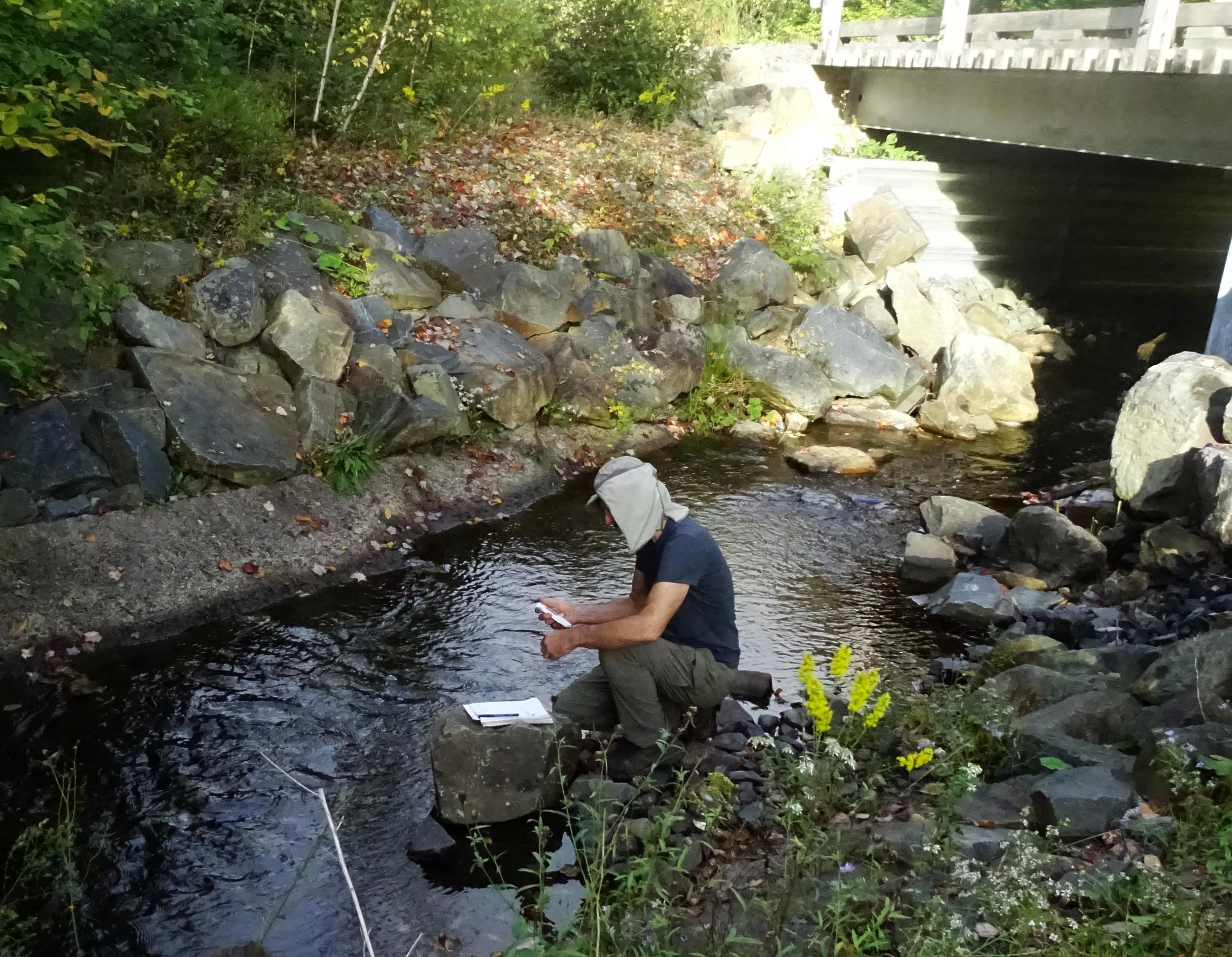
Volunteer Bruce S. measuring stream EC and Temperature on Oct 2, 2020, upper Johnson’s Brook (Sandy Lake watershed)
Click on images for larger versions
At a get-together of volunteers in the Halifax LakeWatchers program earlier this year, a participant asked what observations could be made by volunteers outside of the prescribed limnological sampling.
I suggested that a lot can be learned from measurements of electrical conductivity & temperature using inexpensive “pocket meters”; I commented that I always carry one in the field and routinely measure surface water EC (electrical conductivity) and temperature any time I cross a stream or walk by a lake. In the ensuing discussion, there was general agreement that such measurements can indeed by very informative.
 As a followup, I have revised/updated a page on “EC Notes” on this website which describes, with reference to scientific literature, the ins and outs of such measurements, their interpretation etc. I have added pages describing my use of a particular pocket meter, and summarizing circa a dozen sets of observations in the Williams Lake and Sandy Lake (Bedford) watersheds in the Halifax region.
View
– EC (salt) Notes
and the subpages:
– Examples of “EC Monitoring”
– On our use of a Pocket Water Tester
and the related page:
– Lake Stratification & EC/salt content
EC LEVELS AS A MEASURE OF “POLLUTION”
“Conductivity is useful as a general measure of water quality. Each water body tends to have a relatively constant range of conductivity that, once established, can be used as a baseline for comparison with regular conductivity measurements. Significant changes in conductivity could then be an indicator that a discharge or some other source of pollution has entered the aquatic resource. Significant changes (usually increases) in conductivity may indicate that a discharge or some other source of disturbance has decreased the relative condition or health of the water body and its associated biota. Generally, human disturbance tends to increase the amount of dissolved solids entering waters which results in increased conductivity. Water bodies with elevated conductivity may have other impaired or altered indicators as well.” – USEPA: National Aquatic Resource Surveys/Indicators: Conductivity
“Impervious surface is often used as an indicator of non-point source pollution in urban areas due to the strong relationship between percent impervious surface cover and water-quality impacts” – Impervious surface as an indicator of pH and specific conductance in the urbanizing coastal zone of New Jersey USA., T. Conway, 2007 in Journal of Environmental Management.
The electrical conductivity measurement has been described as providing a “screening of the pollution level” but measurement of particular contaminant concentrations are required to “provide unambiguous information about anthropogenic sources of contaminant discharges.” – Electrical conductivity and emerging contaminant as markers of surface freshwater contamination by wastewater by D.N.R. de Sousa et al. 2014 in Science of The Total Environment
In regard to pollution in the Halifax Region specifically, view item 6. EC as a measure of pollution in the Halifax Region on the EC Notes page.
ON THE SCIENTIFIC VALUE OF THE EC MEASUREMENTS

Volunteer Charles B. conducting measurements on Governor’s Brook (Williams Lake Watershed) Nov 30, 2022
As discussed on the Examples Page
…Various of these sets of observations I have conducted using a pocket meter could be described as “casual”, “formal” and in-between (semi-formal) in nature, formal being a set of observations that one would expect to be accepted as “scientific”. All of them are likely to be considered “citizen science” and will be rejected by some agencies regardless of their scientific rigour.
I am a retired academic scientist. My goal with these observations was not to produce scientific papers but simply to learn as much as I could about factors affecting water quality with the limited resources at hand, the pocket meter being one of them. All of the data and interpretations and methods are posted on this website so that other parties who might be interested in this topic can make their own assessment of the credibility of the observations and critique the interpretations/make their own interpretations.
[On the Examples Page] I am presenting the sets of observations and conclusions in the order in which they were made to illustrate how use of a simple, inexpensive conductivity meter can be very informative to volunteer organizations involved in water quality monitoring/advocacy, how they can supplement the limnological observations conducted under the LakeWatchers program or similar protocols.
– david p
June 24, 2026
Posted 24Jun2026
Edits 25Jin2026