NAVIGATION: EC notes is a page on the website Sandy Lake & Environs (Bedford, Nova Scotia) (www.versicolor.ca/sandylakebedford). It is posted under the top level menu item Surface Waters, full URL: https://versicolor.ca/sandylakebedford/waters/ec-notes/
SUBPAGES
– Examples of “EC Monitoring”
– On our use of a Pocket Water Tester
– from MJL Robin et al. 2003 (on sources of EC)
RELATED PAGE
– Lake Stratification & EC/salt content
RELATED POST (JUN 24, 2026): On the use of electrical conductivity measurements in citizen science monitoring of “pollution” of surface waters in the Halifax NS region
CONTENTS of this page (EC Notes)
1. Definition & Measurement
– a. Electrical Conductivity (EC)
– b. Specific Conductance (Spc, Sec)
– c. Total Dissolved Solids (Tds)
– d. Salt, Salinity
– e. Hardness
2. Typical EC Values
3. Sources & Variation of EC In Fresh Waters
4. Factors Relating EC, TDS And Chloride
5. CCME Guidelines for Chloride and Equivalent EC Values
6. EC as a Measure of Pollution In The Halifax Area
7. More Links & Lit
THIS PAGE describes, with reference to scientific literature, the ins and outs of Electrical Conductivity measurements of surface waters, their interpretation etc. particularly in relation to their use in Citizen Science, and to surface waters in the Halifax (Nova Scotia) region. View related post (June 24, 2026)
1. DEFINITION & MEASUREMENT
1a. Electrical Conductivity (EC) is often referred to as just “Conductivity” It is a property of water routinely included in water quality measurements. Along with temperature and oxygen (and usually pH) it is one of the basic variables that is measured with multi-parameter water-quality instruments to characterize “vertical profiles” of lakes.
Conductivity, in particular specific conductance, is one of the most useful and commonly measured water quality parameters . In addition to being the basis of most salinity and total dissolved solids calculations, conductivity is an early indicator of change in a water system. Most bodies of water maintain a fairly constant conductivity that can be used as a baseline of comparison to future measurements. – from Fondriest
EC is a measure of the capacity of water to conduct electricity, a property than can be measured readily and reliably with very simple instruments.
The standard units for electrical conductivity in fresh waters are microsiemens per centimeter, µS/cm or sometimes without the special symbol for “micro” as uS/cm. Note: 1000 microSiemens/cm (μS/cm) = 1.0 milliSiemen/cm (mS/cm).
EC increases with ionic content.
Conductivity is a measure of water’s capability to pass electrical flow. This ability is directly related to the concentration of ions in the water. These conductive ions come from dissolved salts and inorganic materials such as alkalis, chlorides, sulfides and carbonate compounds.. Compounds that dissolve into ions are also known as electrolytes The more ions that are present, the higher the conductivity of water. Likewise, the fewer ions that are in the water, the less conductive it is. Distilled or deionized water can act as an insulator due to its very low (if not negligible) conductivity value. Sea water, on the other hand, has a very high conductivity. – Read more at Conductivity, Salinity & Total Dissolved Solids: What is Conductivity?on fondriest.com
The “limnologically important ions”* are the cations Ca2+ Mg2+ Na+ K+ NH4+ and the anions HCO3–, SO42-Cl– NO3– F– CO32-; the bolded ions typically account for 99% of the EC.
If all of the major ions (cations and anions) are measured, a “Theoretical Conductivity” can be calculated. Typically the calculated values are very close to observed values; if not it’s an indication that something has been missed in the ion analysis, e.g., metals that could be entering surface waters from mining operations.
*Calculating the conductivity of natural waters by Rich Pawlowicz Limnol. Oceanogr.: Methods 6, 2008, 489–501. Also view A Simplified Model to Estimate the Concentration of Inorganic Ions and Heavy Metals in Rivers by Clemêncio Nhantumbo et al., Water 2016, 8, 453
1b. Specific Conductance (SPC, SEC) is the EC at 25°C
Conductivity increases approximately 2-3% per 1°C increase in temperature, though in pure water it will increase approximately 5% per 1°C. This variation is why many professionals use a standardized comparison of conductivity, known as specific conductance, that is temperature corrected to 25°C – from Fondriest
The meter we have been using for most EC measurements, the AP-2: AquaPro Water Quality Tester (EC) provides Automatic Temperature Compensation.
1c. TDS or Total Dissolved Solids is the weight of all particles smaller than 2 microns in water, expressed as milligrams per liter, mg/L and is measured by measuring the weight remaining when all of the water in a sample has evaporated. In “clean water”, TDS are made up mostly of ionic substances and there is a close relationship between TDS and EC, so TDS can be estimated from the more readily measured EC. The exact relationship varies with ionic composition (see Fondriest article). “Dirty water” may include significant components of small non-ionic substances such as urea and hydrocarbons; for such waters, there may be a very poor relationship between TDS and EC (see Rusydi, 2018* for examples).
*Correlation between conductivity and total dissolved solid in various type of water: A review, Anna F Rusydi, 2018 IOP Conference Series: Earth and Environmental Science, 118: 012019
1d. Salt, Salinity EC increases with increasing content of “salts” as defined chemically, so EC could be thought of as a measure of the salt content. “Salty waters” are waters with sufficiently high content of common ions that they taste “salty”. “Salinity” is a term generally applied only to seawater. Seawater has highly consistent proportions of the major ions and so there is a highly consistent relationship between “salinity” as traditionally measured in seawater* and electrical conductivity; today salinity of seawater is generally determined by measuring its electrical conductivity and applying particular formulas or conversion factors to give the “salinity” in units that describe the weight of salt in a kilogram of seawater, typically g/kg or “parts per thousand”, ppt.
Typical seawater has values in the range of about 32 to 35 g salt/kilogram of water (32-35 ppt).
__________________
*By determination of chloride content or the “chlorinity”; or from measurement of the weight of a sample of water of known volume at a known temperature, i.e. its “density”, the weight per unit volume.
The units for salinity are similar to units for TDS, except TDS is expressed per liter of water not per kilogram; one kilogram of pure water occupies one liter (a density of 1 g/mL) at 4 deg C. The differences are very small numerically, but can be important in relation to oceanographic calculations that involve density.
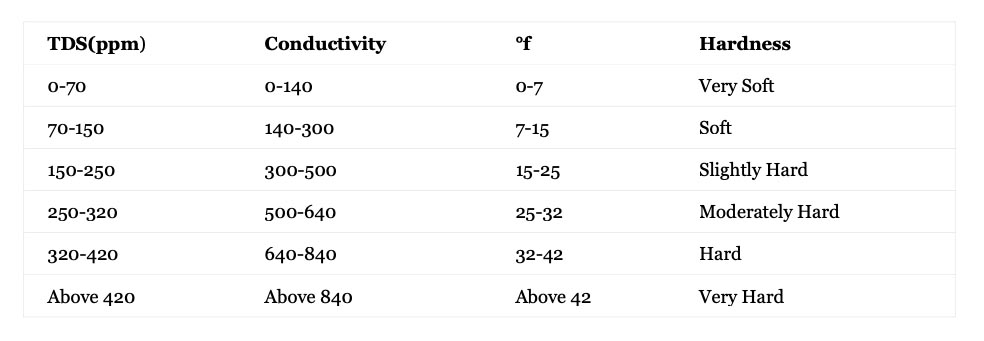
1e Hardness “Water hardness is the measurement of the number of ions that have lost two electrons (divalent cations) dissolved in the tested water and is, therefore, related to total dissolved solids. The more divalent cations dissolved in the water, the “harder” the water. Generally, the most common divalent cations are calcium and magnesium. However, other divalent cations may contribute, including iron, strontium, aluminum, and manganese. Typically the other divalent cations contribute little to no appreciable additions to the water hardness measurement.
“A stream or river’s hardness reflects the geology of the catchment’s area and sometimes provides a measure of the influence of human activity in a watershed. For example, sites that have active or abandoned mines nearby often have higher concentrations of iron ions in the water resulting in a very high hardness degree…
“While conductivity is a convenient way to get an approximation of the hardness of water, it does have the drawback of combining all ions in the measurement, including those that do not contribute to the water’s hardness. This hardness approximation gives an error similar to the TDS measurement of 2-3 French degrees of hardness.
“Can you measure water hardness with a conductivity sensor or TDS sensor? Yes, however, it depends on the accuracy that you want to have in your measurement. In general, the following table describes the water hardness as measured by a TDS, conductivity, or hardness measurement” SOURCE: YSI-Water Hardness
2. TYPICAL EC VALUES
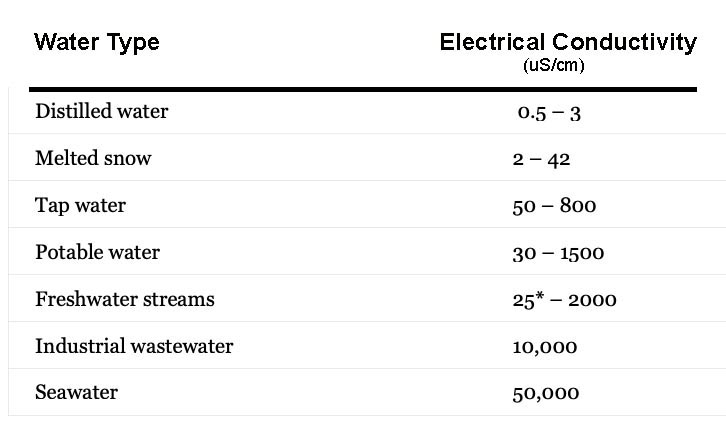
From Conductivity, Salinity & Total Dissolved Solids: What is Conductivity on fondriest.com; except that the lowest value for freshwater streams was changed from 100 to 25 to better represent values in Nova Scotia.
In the Halifax area, EC values of pristine lakes and associated streams typically fall within the range 30-60 uS/cm – View Synoptic water quality survey of selected Halifax-area lakes : 2011 results and comparison with previous surveys Pierre M. Clement and Donald C. Gordon 2011. Can. Manuscr. Rep. Fish. Aquat. Sci. 3170: xi + 98 p. Also: Nova Scotia Lake Chemistry Data (NS Gov website)
3. SOURCES & VARIATION OF EC IN FRESH WATERS
There are many possible sources or agents of EC in fresh waters, and many factors can contribute to variation in EC. Below are some of the more commonly identified sources and factors. Also view Factors influencing EC cited by MJL Robin et al. 2003.
3 (i) Bedrock & Soils
In streams and rivers, normal conductivity levels come from the surrounding geology. Clay soils will contribute to conductivity, while granite bedrock will not. The minerals in clay will ionize as they dissolve, while granite remains inert. Likewise, groundwater inflows will contribute to the conductivity of the stream or river depending on the geology that the groundwater flows through. Groundwater that is heavily ionized from dissolved minerals will increase the conductivity of the water into which it flows. – from Fondriest: Conductivity, Salinity & Total Dissolved Solids
In Nova Scotia, exposure of pyritic shales to air and water can result in sudden flushes of very acidic water, also characterized by high electrical conductivity due to the dissolved iron sulfate*
*See “WALKING THE RIVER” A Citizen’s Guide to Interpreting Water Quality Data, Nova Scotia Salmon Association, April 2014, Appendix 3. Related: Healing am open sore: rehabilitation of former shale quarries in Nova Scotia by Scott MacKnight in Nova Scotia Mineral Review, 2005
3 (ii) Ecoregion
EC tends to vary with Ecoregions which are “areas of relative homogeneity based on landuse, soils, land and surface form, and potential natural vegetation” – see Water on the Web/Ecoregions for examples.
3 (iii) Area of watershed/Area of Lake
The size of the watershed (lake basin) relative to the area of the lake (Aw : Ao ratio) – A bigger watershed to lake surface area means relatively more water draining into the lake because of a bigger catchment area, and more contact with soil before reaching the lake. (On Water on the Web: Electrical Conductivity)
3 (iv) Clearcutting/Soil Disturbance
– Effects of Forest Cutting and Herbicide Treatment on Nutrient Budgets in the Hubbard Brook Watershed‐Ecosystem
Gene E. Likens et al., 1970. A classic field scale experiment. “All vegetation on Watershed 2 of the Hubbard Brook Experimental Forest was cut during November and December of 1965, and vegetation regrowth was inhibited for two years by periodic application of herbicides…Electrical conductivity increased about 6—fold in the stream water after deforestation and was much more variable.”

From Martin et al., 1986
– Clearcutting affects stream chemistry in the White Mountains of New Hampshire,
C. Wayne Martin et al., 1986 Res. Pap. NE-579. Broomall, PA: U.S. Department of Agriculture, Forest Service, Northeastern Forest Experiment Station. 12 p. “Commercial clearcutting of northern hardwood forests changed the chemistry of the streams that drained from them. By the second year after cutting, specific conductance doubled, nitrate increased tenfold, calcium tripled, and sodium, magnesium, and potassium doubled. Chloride and ammonium did not change; sulfate decreased. Concentrations of most ions returned to reference levels after 4 years, though sulfate remained depressed, potassium remained elevated, and acidity decreased.”
– On-farm measurements of pH, electrical conductivity and nitrate in soil extracts for monitoring coupling and decoupling of nutrient cycles
D.G. Patriquin et al., 1993. Biological Agriculture and Horticulture 9: 231-272. The paper illustrates how electrical conductivity of 1:1 water extracts of soils from a wide range of agricultural systems geographically (including eastern Canada) and type (e.g., organic versus conventional management) is increased when agricultural fields are cultivated, and when rapidly decomposing residues are added to soils; electrical conductivity is lowered by plant growth and by addition of low nitrogen, “immobilizing” residues to soils. Full text available here. For followup on this research, see Google Scholar docs.
3 (v) Solubilization of Iron and Manganese in the Hypolimnion
– The Exchange of Dissolved Substances between Mud and Water in Lakes
Clifford H. Mortimer 1942. Journal of Ecology 30: 147-201 Classic (foundational) paper linking solubilization of iron and manganese and phosphorus under anoxic conditions. Over the anoxic period, EC rose by about 40 uS/cm<
– Chesley Lake 1991 Water Quality Assessment
Ontario Ministry of Environment, 1993. The paper Illustrates increase in electrical conductivity of about 30 uS/cm in hypolimnion water associated with anoxia and release of iron and manganese. Phosphorous is also released.
– Water Quality Assessments: A Guide to Use of Biota, Sediments and Water in Environmental Monitoring
Second Edition Edited by Deborah Chapman © 1992, 1996 UNESCO/WHO/UNEP. p. 338: “Depletion of oxygen in lake bottom waters and the onset of anoxia results in the remobilisation of phosphorus and other elements from lake sediments. This mechanism was described by Mortimer (1942) and has been the subject of many investigations. Project Hypo (Bums and Ross, 1971) followed the release of phosphorus during anoxia in the hypolimnion of Lake Erie. It was also noted that with decreasing redox potential, manganese was the first element to be released from bottom sediments to the hypolimnion, followed by the synchronous release of iron and phosphorus. The association of phosphorus with iron in bottom sediments has been well established (e.g. Williams et al., 1976) and the reduction of Fe3+ to soluble Fe2+ results in the release of phosphorus. Other elements adsorbed by, or co-precipitated with, the oxides of iron and manganese are also released to the bottom waters under anoxic conditions.”
3 (vi) Bacterial Metabolism in the Hypolimnion
“…When lakes are thermally stratified for long periods of time (in Minnesota this might be May – November depending on the basin shape, lake depth and weather). During this period, there is a steady “rain” of detritus (dead stuff, mostly algae and washed in particulate material from the watershed) down to the bottom. This material is decomposed by bacteria in the water column and after it reaches the sediments. Their metabolism releases the potential energy stored in the chemical bonds of the organic carbon compounds, consumes oxygen in oxidizing these compounds, and releases carbon dioxide (CO2) after the energy has been liberated (burned). This CO2 rapidly dissolves in water to form carbonic acid (H2CO3), bicarbonate ions (HCO3- ) and carbonate ions (CO3-) the relative amounts depending on the pH of the water. This newly created acid gradually decreases the pH of the water and the “new” ions increase the TDS, and therefore the EC, of the hypolimnion.” – On Water on the Web
3 (vii) Wastewater
– wastewater from sewage treatment plants (point source)
– wastewater from septic systems and drainfield on-site wastewater treatment and disposal systems (nonpoint source) Info Source: Water on the Web: Conductivity
-Home wastewater, e.g., associated with use of table salt, water softeners
Info Source: Chlorides in Fresh Water by Molly Hunt et al., 2012 URI WATERSHED WATCH 4, March 2012
Also view: Electrical conductivity and emerging contaminant as markers of surface freshwater contamination by wastewater by D.N.R. de Sousa et al. 2014 in Science of The Total Environment “The use of chemical markers of undoubted anthropogenic sources for surface freshwater contamination by wastewaters was evaluated employing correlations observed between measured physico-chemical parameters as the electrical conductivity and the concentration of different emerging organic compounds…The electrical conductivity measurement by itself is useful in providing a screening of the pollution level but, when in association with emerging contaminant concentrations, can provide unambiguous information about anthropogenic sources of contaminant discharges.”
3 (viii) Fertilizers
Agricultural runoff of water draining agricultural fields [& lawns, turfs etc] typically has extremely high levels of dissolved salts, mostly due to potash (potassium chloride and/or potassium sulfate).
3 (ix) Roadsalts
From Chlorides in Fresh Water by Molly Hunt et al. 2012:
“The use of road salts for deicing in snow-belt states such as Rhode Island began in the 1940s and sharply increased in the 1970s. Chlorides are the “active” ingredient in most commercial deicers, whether they are made with sodium chloride or new alternatives like potassium chloride. When ice and snow begin to melt in the winter and spring, chloride concentrations spike in roadside streams due to road runoff. When roads are pretreated in anticipation of snow and ice but precipitation comes as rain, chloride from pretreatments is washed off with stormwater. Uncovered salt storage piles lose about 20% of their salt each year, much of which finds its way into nearby waterways.
“Chloride concentrations tend to be higher in areas with pavement and other treated surfaces because stormwater and snowmelt runoff does not have a chance to soak into the ground before entering rivers, lakes, and streams. Road salts travel farther from roads when the speed limit is high; they have been observed traveling over 40m (130 ft) from the side of major highways (Karraker, 2008). Concern over the release of sodium into the environment has prompted many communities to switch to other chloride road salts; however, these salts may be more toxic to aquatic organisms than sodium chloride road salts (Mount et al., 1997). Commercial road salts have phosphorus compounds added to keep them from clumping, contributing nutrient increases in lakes and streams. Road salts often have heavy metal additives, so high chloride concentrations may indicate the presence of other harmful substances in lakes and streams.”
3 (x) Acid Rain/Watershed effects
– Population density of Brown trout (Salmo trutta) in extremely dilute water qualities in mountain lakes in southwestern Norway.
Enge, E.; Kroglund, F. 2011 Water, Air, Soil Pollut.219, 489−499. We have examined populations of brown trout in low conductivity mountain lakes (5.0-13.7 uS/cm and 0.14-0.41 mg/l Ca) in southwestern Norway during the period 2000-2010. Inlets to the lakes were occasionally even more dilute (2007; conductivity = 2.9-4.8 mu S/cm and Ca = 0.06-0.17 mg/l). The combination of pH and conductivity was the best predictor to fish status (CPUE), indicating that availability of essential ions was the primary restricting factor to fish populations in these extremely diluted water qualities. We suggest that conductivity < 5 mu S/cm is detrimental to early life stages of brown trout, and subsequently that there are lakes in these mountains having too low conductivity to support self-reproducing trout populations. Limited significance of alkalinity, Ca, Al, and color suggests that effects of ion deficit apparently overruled the effects of other parameters.
Also view: EC & Lake Stratification (This Website)
3 (xi) Urban Development – HRM
– Identifying lake water quality trends and effective monitoring strategies in a rapidly urbanizing region
Casey Doucet, 2022. Masters Thesis, Dalhousie University “This thesis analyzed water quality trends in a set of ~50 lakes that have been sampled on a decadal-basis over a 40-year period in the Halifax Regional Municipality (HRM). Trophic state was also tracked in a subset of lakes over the 2021 open-water season to evaluate common and novel strategies for monitoring lake health. Aluminum, chloride, manganese, and arsenic concentrations were found to exceed national guidelines for the protection of aquatic life in one or more of the study lakes in 2021. Urban development was identified as an important driver of increasing chloride, conductivity, sodium, calcium, and total phosphorus (TP) concentrations. Regional factors, including climate change and decreasing acid deposition, hydrology, and watershed characteristics are believed to be stronger drivers of other observed changes. Decadal spring synoptic surface sampling was determined to be useful at highlighting emerging water quality concerns but may be less effective at characterizing parameters that are more spatially and temporally variable, such as nutrients, particularly in lakes where internal P loading occurs.
– Assessing and predicting Lake Chloride Concentrations in the Lake-Rich Urbanizing Halifax Region, Canada
Tessa Bermarija et al., 2023 in Journal of Hydrology “Highlights• [Cl-] was correlated with urban cover, road density, and stormwater pipe density. • Annual Cl- loading rates were developed for urban land uses.• A mass balance model was developed to predict Cl- loading to lakes.
– Long-term evaluation of the impact of urbanization on chloride levels in lakes in a temperate region
Scott et al., 2019. J. Environ. Manag. The application of road salts for winter de-icing of roadways in cold regions has been demonstrated to increase chloride (Cl) concentrations in nearby surface waters and have a negative impact on aquatic organisms and processes. In addition to toxicity to aquatic organisms, high concentrations of Cl in lakes can alter mixing processes, resulting in prolonged anoxic conditions and associated water quality degradation. Elevated concentrations of Cl in freshwater environments in cold regions is a well-documented phenomenon, but few studies have undertaken a long-term evaluation of the impact of urbanization on lakes. In this paper, nine lakes in the Halifax region of Nova Scotia, Canada, were monitored over 35 years to observe Cl concentrations prior to, during, and after urbanizing development. Cl concentrations were observed to increase in most study lakes over the monitoring period and all nine exhibited seasonal trending in response to winter de-icing activities. Six of the lakes achieved a steady-state Cl level after an initial increase in response to development activities, two are potentially still in transition, and one was unaffected by development activities. Watershed land use was found to be a good predictor of the springtime concentration of Cl and can help to inform decision-making surrounding development activities. When the percent of developed land was 25% or more, the Cl concentrations tended to exceed Canadian freshwater quality guidelines for the protection of aquatic life.”
– Effect of Road Salt on Soil and Water Properties in Halifax, Nova Scotia
Sahana J. Kanabar Honours Thresis, SMU
– Applied landscape geochemistry and environmental change in Nova Scotia, Canada
P Rogers, W Jones – Atlantic Geology, 2018
3 (xii) Urban Development – Globally
– Impacts of Expanding Impervious Surface on Specific Conductance in Urbanizing Streams
M. E. Baker et al., 2019 in Water Resources Research Long‐term analysis indicates that progressive salinization of freshwaters is widespread. Although increases are often associated with urbanization, knowledge of chemical dynamics during urbanization is limited and typically drawn from space‐for‐time studies. Thus, the potential role of stream chemistry in sharp biodiversity losses observed at low levels of urbanization is difficult to distinguish from other concurrent factors such as temperature, flow, or sediment. We used a 25‐year annual time series of impervious cover for the Baltimore‐Washington, DC, metropolitan area to interpret long‐term records from 12 watershed‐monitoring stations in the Mid‐Atlantic Piedmont USA from 1986 to 2010 and explore stream conductivity under progressive urbanization. All 12 watersheds experienced variable but monotonic increases in impervious cover, which ranged from <1% to nearly 25% of contributing area. All monitoring stations exhibited elevated specific conductance relative to background concentrations. Proliferation of impervious cover led to seasonal shifts in monthly conductivity maxima, with progressive dominance of winter pulses and diminishing signal from evapotranspirative concentration in late summer. We found consistently steep increases in stream conductivity across years and seasons associated with incremental increases in low (0‐4.5%) levels of watershed impervious cover; moderate to low rates of increase, but distinct seasonal concentrations from 4.5 to 13.8% impervious cover; and increasing predominance of pulses at high levels of impervious cover (>13.8%), particularly when conditioned on winter storm events. Observed patterns may suggest distinct sources and different degrees of hydrologic connection. Despite ubiquitous increases, variability in conductivity trends across space and time underscores the need for more intensive monitoring as urbanization progresses.
Select references:
– Conway, T. (2007). Impervious surface as an indicator of pH and specific conductance in the urbanizing coastal zone of New Jersey, USA. Journal of Environmental Management, 85(2), 308–316. https://doi.org/10.1016/j.jenvman.2006.09.023 “Impervious surface is often used as an indicator of non-point source pollution in urban areas due to the strong relationship between percent impervious surface cover and water-quality impacts. In many cases, a threshold effect exists where water quality rapidly degrades above a given percent cover, but the exact threshold level appears to vary across regions. This study explores the relationship between pH, specific conductance, and percent impervious surface cover in the urbanizing coastal zone of New Jersey (USA) to determine the nature of the relationship in the region. The results of the analysis suggest the system is very sensitive to impervious surface, with a threshold potentially existing between 2.4% and 5.1% impervious surface cover. An examination of future conditions suggests that by 2020 water quality in more than 50% of the catchments in the study area will be negatively impacted by non-point source pollution associated with impervious surface.”Griffith, M. (2014).
– Natural variation and current reference for specific conductivity and major ions in wadeable streams of the conterminous USA. Freshwater Science, 33(1), 1–17. https://doi.org/10.1086/674704Hatt, B., Fletcher, T., Walsh, C., & Taylor, S. (2004).
– The influence of urban density and drainage on the concentrations and loads of pollutants in streams. Environmental Management, 34(1), 112–124. https://doi.org/10.1007/s00267‐004‐0221‐8Kaushal, S. S., Likens, G. E., Pace, M. L., Utz, R. M., Haq, S., Gorman, J., & Grese, M. (2018).
– Freshwater salinization syndrome on a continental scale. Proceedings of the National Academy of Sciences, 115(4), E574–E583. https://doi.org/10.1073/pnas.1711234115Olson, J. R., & Cormier, S. M. (2019). Modeling Spatial and Temporal Variation in Natural Background Specific Conductivity. Environmental Science & Technology, 53(8), 4316–4325. https://doi.org/10.1021/acs.est.8b06777
– Wright, I., Davies, P., Findlay, S., & Jonasson, O. (2011). A new type of water pollution: concrete drainage infrastructure and geochemical contamination of urban waters. Marine and Freshwater Research, 62(12), 1355–1361. https://doi.org/10.1071/MF102964.
4. FACTORS RELATING EC, TDS AND CHLORIDE
– Using Electrical Conductivity and Total Dissolved Solids Meters to Field Test Water Quality
Tom Scherer et al., 2019. North Dakota State University. Electrical Conductivity (EC) as a measure of the TDS content (view conversion factors)
– Conductivity, Salinity and Total Dissolved Solids
Fondriest Environmental, Inc. 3 Mar 2014. Web. Units of measurement etc.
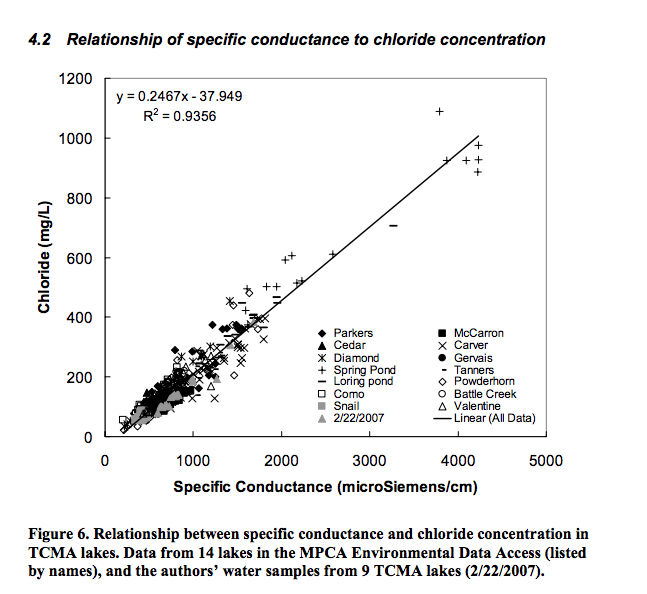
From Novotny et al., 2007
– Road Salt Effects on the Water Quality of Lakes in the Twin Cities Metropolitan Area
Novotny et al. 2007. ST. ANTHONY FALLS LABORATORY Engineering, Environmental and Geophysical Fluid Dynamics Project Report No. 505[Cl-] = 0.2467 * SC – 37.949. where [Cl-] is the chloride concentration in mg/L and SC is the specific conductance in µS/cm. This equation was used to convert specific conductance measurements to chloride concentrations. (R2 = 0.96).
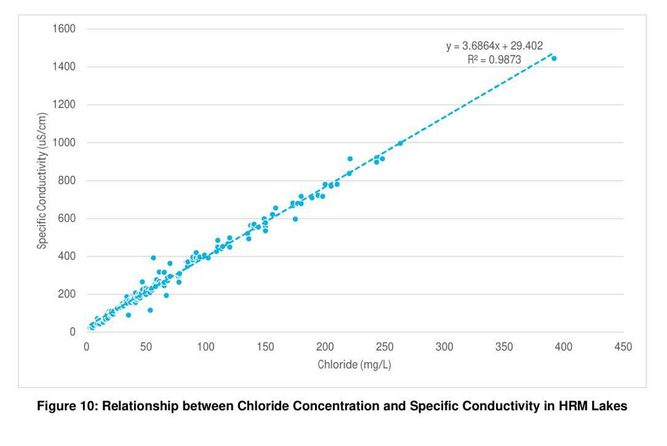
From AECOM 2020
– “AECOM 2020”Halifax Regional Municipality Water Quality Monitoring Policy and Program Development (PDF)
Prepared by: AECOM Canada Ltd., Sep 2020 99 pages + Appendices.
Chloride Concentration (mg/L) = 0.268 * Specific Conductivity (µS/cm) — 6.9
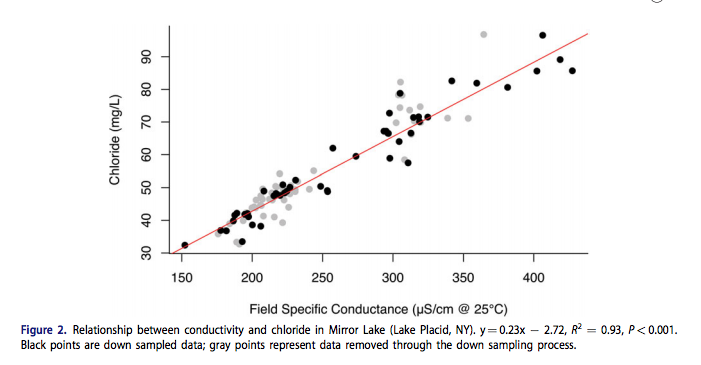
From Wiltse et al., 2019
– A reduction in spring mixing due to road salt runoff entering Mirror Lake (Lake Placid, NY)
by B. Wiltse et al., 2019, Lake and Reservoir Management 36:109–121 [Cl-]=0.23 * SC -2.72
– Williams Lake, Halifax. Nova Scotia: An Investigation of the Aquatic Ecosystem of an Urbanizing Watershed
Scott, R. 1992. Report to Nova Scotia Department of the Environment, 39 pp
Scott (1992) observed a close linear relationship between chloride and specific conductance: Chloride (mg/L) = 0.202 (specific conductance umhos/cm) + 2.48 (r2 = 0.981, n = 68)
Conversion of EC (uS/cm) to chloride (mg/L)
Calculated values of chloride corresponding to EC values in range 50 to 2000 µS/cm based on Scott 1992, Wiltse et al., 2019, AECOM 2020 (cited above):
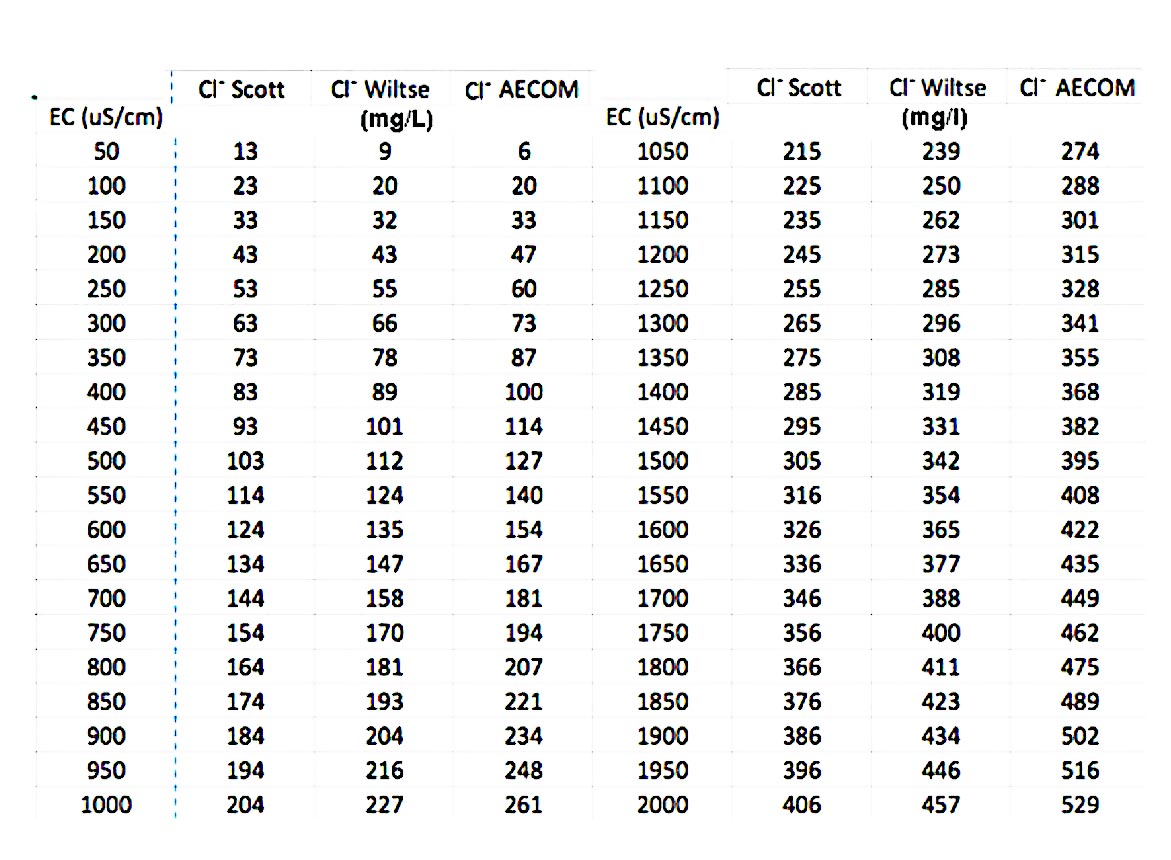

Fig 3 in On-Farm Measurements of pH, Electrical Conductivity and Nitrate in Soil Extracts for Monitoring Coupling and Decoupling of Nutrient Cycles by DG Patriquin et al., 1993
Note that these relationships between EC and chloride occur where there is routine use of road salts.
In situations where road salts are not used, electrical conductivity may be closely related to other ions/processes.
For example, in cultivated soils, nitrification tends to be the most important biological process acidifying soil and bringing cations into solution and conductivity of soil extracts was found to be a good predictor of – was closely related to – nitrate levels in the extracts for soil samples taken from farms in eastern Canada and Maine.
5. CCME WATER QUALITY GUIDELINES FOR CHLORIDE,
AND EQUIVALENT EC VALUES
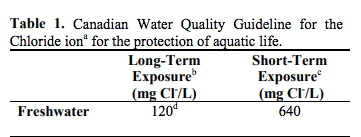
From CCME. 120 mg chloride/L=581 uS/cm & 640 mg chloride/L=3156 µS/cm by the Scott relationship
By the conversion given in AECOM 2020 for Halifax area lakes:
– 120 mg/L Cl– is equivalent to 474 µS/cm
– 640 mg/L Cl– is equivalent to 2414 /µS/cm
6. EC AS A MEASURE OF POLLUTION IN THE HALIFAX AREA
In the Halifax area, EC or SPC values of pristine lakes and associated streams typically fall within the range 30-60 µS/cm.
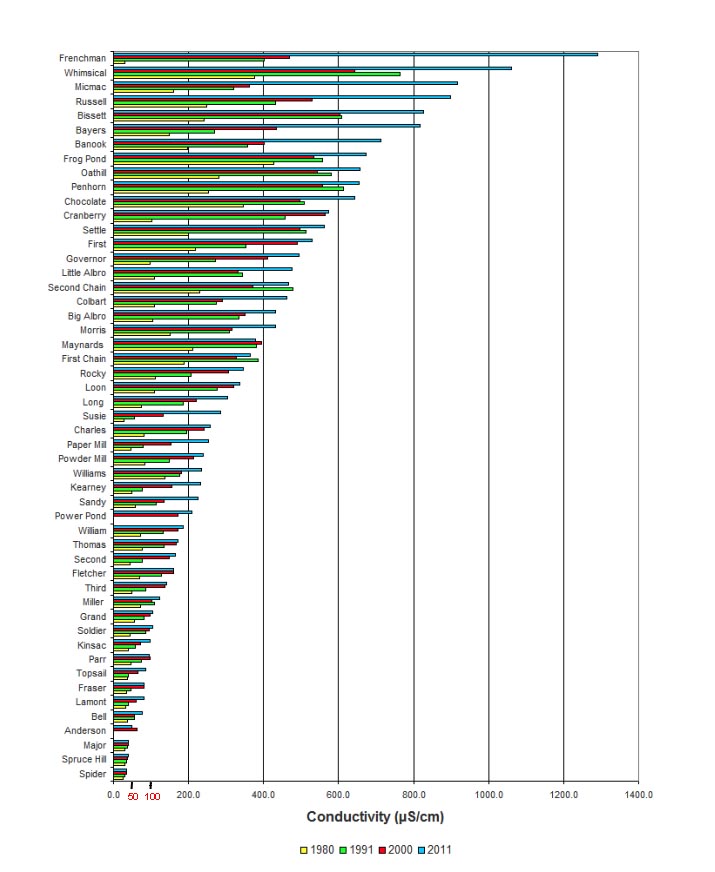
Conductivity readings of Selected Halifax-Area Lakes 1980, 1991, 2000, 2011. Figure 5 from Clement & Gordon, 2019. I have inserted scale markers on the x-axis corresponding to 50 and 100 uS/cm.
Comment Clement & Gordon 2019* (paragraphing inserted):
“A wide range of conductivity readings is found in the Halifax-area lakes (Figure 5).
“The highest reading was 1600 μS/cm in Frenchman Lake while the lowest reading was 25 μS/cm in Spider Lake.
“As in previous surveys, the lakes with the lowest conductivity have relatively undisturbed watersheds (e.g. Spider, Major, Spruce Hill, Anderson).
“These natural levels reflect the dissolution of minerals from the weathering of bedrock and soil and the input of wind-blown sea salt.
“The highest values were found in lakes with well-developed watersheds (e.g. Frenchman, Whimsical, Micmac, Russell) and reflect the addition of anthropogenic contaminants such as road salt, lime and fertilizers. These chemicals are water-soluble and enter the lakes through storm water runoff.
“Atmospheric pollutants added to lakes by precipitation can also elevate conductivity readings…Overall, there has been a marked increase in mean conductivity of the lakes sampled over the 31-year observation period…”
*Pierre M. Clement and Donald C. Gordon, 2019. Synoptic Water Quality Study of Selected Halifax-Area Lakes: 2011 Results and Comparison with Previous Surveys. Canadian Manuscript Report of Fisheries and Aquatic Sciences # 3170.
Also view above under section 3 (SOURCES & VARIATION OF EC IN FRESH WATERS),
– 3 (vii) Wastewater
– 3 (xi) Urban Development – HRM
– 3 (xii) Urban Development – Globally
7. MORE LINKS & LIT
Electrical conductance – a versatile guide in freshwater science
JF Talling in Freshwater Reviews (2009) 2, pp. 65-78. PDF(available separately)
Technical Note: Electrical Conductivity – A useful tool for investigating catchment hydrology.
August 30, 2016 by EPA Catchments Unit on www.catchments.ie
Can you determine water hardness from conductivity or total dissolved solids measurements?
On global.com
The conductivity of low concentrations of co2 dissolved in ultrapure water from 0-100°c
Truman S. Light et al., 1995. Paper presented at the 209th American Chemical Society National Meeting, Anaheim, CA, April 2-6, 1995
A practical approach to lake water density from electrical conductivity and temperature
Santiago Moreira et al., 2016 Hydrol. Earth Syst. Sci., 20, 2975–2986
Can we keep our freshwater fresh?
By Angela Wallace, Calvin Hitch, Jonathan Ruppert, Krista Chomicki, Lyndsay Cartwright, and Tim VanSeters -March 11, 2022 for Water Canada
Road Salt and Water Quality
New Hampshire Dept Environment Doc WMB-4, published 2021. Includes descriptions of various types of salt and additives
Local determinants influencing stream water quality
Aadil Hamid et al., 2020 in Applied Water Science “Understanding how coupled effect of natural and anthropogenic factors controls stream water quality parameters and how the relationships change over space and time will help policy makers and resource managers to target appropriate scales at watershed level for the quality management of stream waters. The present paper provides a detailed account of various natural and anthropogenic factors responsible for conditioning and shaping water quality in stream ecosystems.”
A Field-Based Aquatic Life Benchmark for Conductivity in Central Appalachian Streams.
U.S. EPA (Environmental Protection Agency). 2011.Office of Research and Development, National Center for Environmental Assessment, Washington, DC. EPA/600/R-10/023 “This report uses field data to derive an aquatic life benchmark for conductivity that can be applied to waters in the Appalachian Region that are dominated by salts of Ca2+, Mg2+, SO42− and HCO3– at a circum-neutral to mildly alkaline pH. This benchmark is intended to protect the aquatic life in the region.
River Health Deep Dive – Understanding Conductivity
by James River Association Intern | Jul 11, 2025 | James River Watch, News “Each week, our dedicated James River Watch volunteers head out across the watershed to monitor key indicators of river health. One of these often-overlooked yet crucial measurements is conductivity, a simple test with powerful insights. Understanding conductivity helps us uncover what’s dissolved in the river, offering clues about pollution, runoff, and environmental change…Why does Conductivity matter for river health? Ecological Impact-Aquatic Life Sensitivity: Different aquatic species thrive within specific conductivity ranges. Spikes in conductivity, especially from pollution, can be harmful to sensitive organisms like insects, mussels, and fish. -Indicator of Pollution: High conductivity can signal the presence of urban runoff, fertilizers, road salts, or industrial discharges. – Human Impact: Conductivity also matters when it comes to human health, especially for communities that rely on the James River and its tributaries for drinking water. While conductivity doesn’t directly identify specific pollutants, it serves as a red flag.”
Road salt impact on soil electrical conductivity across an urban landscape
Thomas P Shannon, 2020 in Journal of Urban Ecology “This article investigates the degree to which soils across a heterogeneous urban landscape retain salts. We measured the electrical conductivity (EC) of soils in an urban setting. Land covers included forests, grasslands, open spaces, low- and medium-density developments and along roadsides. We found that across land-cover types, soil carbon and porosity were correlated to EC in late summer, which suggests that pore space is an important and long-lasting reservoir for salt. In addition, more developed areas, had higher mean soil EC and greater EC variability within and between sites, with 75% of overall variance occurring within individual sites. We hypothesize that this within-site heterogeneity is driven by anthropogenic modifications to salt inputs and soil characteristics. The high EC variance in highly developed urban soils is a previously undiscussed phenomenon and highlights the fine-scale complexity of heterogeneous urban landscapes and the need for high-resolution sampling to accurately characterize urban ecosystems.”
The influence of ion composition of water on its electrical conductivity
Ivan Tikhonov in tiwater.info “…knowing the value of water conductivity, we can determine the concentration of ions in the water. But here the question arises. How can we reliably determine the salinity of water (the total mass of water ions referred to 1 liter) if the water contains not one specific salt, but several salts?”
A new approach for describing the relationship between electrical conductivity and major anion concentration in natural waters
Andres Marandi et al., 2013 in Applied Geochemistry “…The concentrations of dissolved cations and anions are fundamental to the water quality of groundwaters, particularily pertaining to their use as a drinking water source. Currently, assessment of total dissolved solids requires laboratory-based analysis of each ionic species, and cannot be reliably tested in the field. Here, a new method is developed that distinguishes between changes in ion concentration or water type based upon field measurement of Electric Conductivity (EC) and the concentration of only one anion. The approach operates under the assumption that all cations contribute equally to EC, whereas almost twice as much of the ion is needed to produce the same effect on total solute EC as those of Cl− or ions for waters at neutral pH. Therefore, many groundwater systems can be treated as two anion systems when the groundwater chemical type and solute EC relationship is assessed…“
A new method of calculating electrical conductivity with applications to natural waters
R. Blaine McCleskey et al., 2012 in Geochimica et Cosmochimica Acta “A new method is presented for calculating the electrical conductivity of natural waters that is accurate over a large range of effective ionic strength (0.0004–0.7 mol kg−1), temperature (0–95 °C), pH (1–10), and conductivity (30–70,000 μS cm−1). The method incorporates a reliable set of equations to calculate the ionic molal conductivities of cations and anions …”
Page created Feb 3, 2021