
ObsSG-Bath: Observations of Seagrasses at Bath
 Navigation
Barbados Fringing Reefs & Seagrass Beds
Natural History Perspectives of a Visiter
– ObsSG-Bath (This Page, a top-level page) Other top-level SG Observation Pages:
– ObsSG
– ObsSG-SL
Also view on this website:
– About:Seagrass Beds in Barbados
– Lit & Links/BB Seagrass
| SUBPAGES – Historical Imagery – – Bath 1968-70 – – Bath 1994 – – Bath 2005 – – Bath 2011-i – – Bath 2011-ii – – Bath 2015-i – – Bath 2015-ii – – Bath 2015-iii – – Bath 2017 – – Bath 2024/5 – Bath Corals 28Mar2024 and 1Mar2015 |
– 1969 Seagrass Map – Survey Methods – 1969 Bathymetry & Substrates – 1969 Flora & Fauna – Bath Stations – Transect Observations ’69 & ’94 – Species List – – Bath Rhodoliths – Stn Data ’69-’94-2015 – Sargassum weed – Links – – Related Posts (this website) |
ON THIS PAGE (Drafting...)
THE WAVE-THRASHED EAST COAST
Bath is one of the few areas on the wave-thrashed east coast of Barbados where one can swim and snorkel in relatively protected waters, at least on some days and when the tide is low. Write Brathwaite, Oxenford and Roach in Barbados, A Coral Paradise (2008):
The powerful, rolling ocean waves and crashing breakers of the east coast provide a high energy and formidable undersea environment. These waves, coupled with continued re-suspension of eroded clays brought down by rivers from the Scotland District, mean that few corals exist anywhere offshore between Bathsheba and Gay’s Cove. At Cattlewash and Bathsheba huge boulders of Pleistocene limestone, the work of long dead corals, take a battering in the breaker zone. Further south at Bath and Conset, a shallow coastal lagoon is protected on its seaward side by a reef crest made up of coral rock boulders, supporting a few colonies of fire coral, brain corals and an abundance of macroalgae. Beyond this and stretching some distance offshore is an algal and gorgonian pavement.
SEAWEEDS AND SEAGRASSES AT BATH (drafting…)
I first visited Bath in February of 1966. I had been invited by my McGill University Phycology (algae) class Prof, Mel Goldstein, to assist him and William Randolph Taylor in collecting seaweed specimens in Barbados. We were based at the Bellairs Research Institute (McGill University) located in Holetown, Barbados.
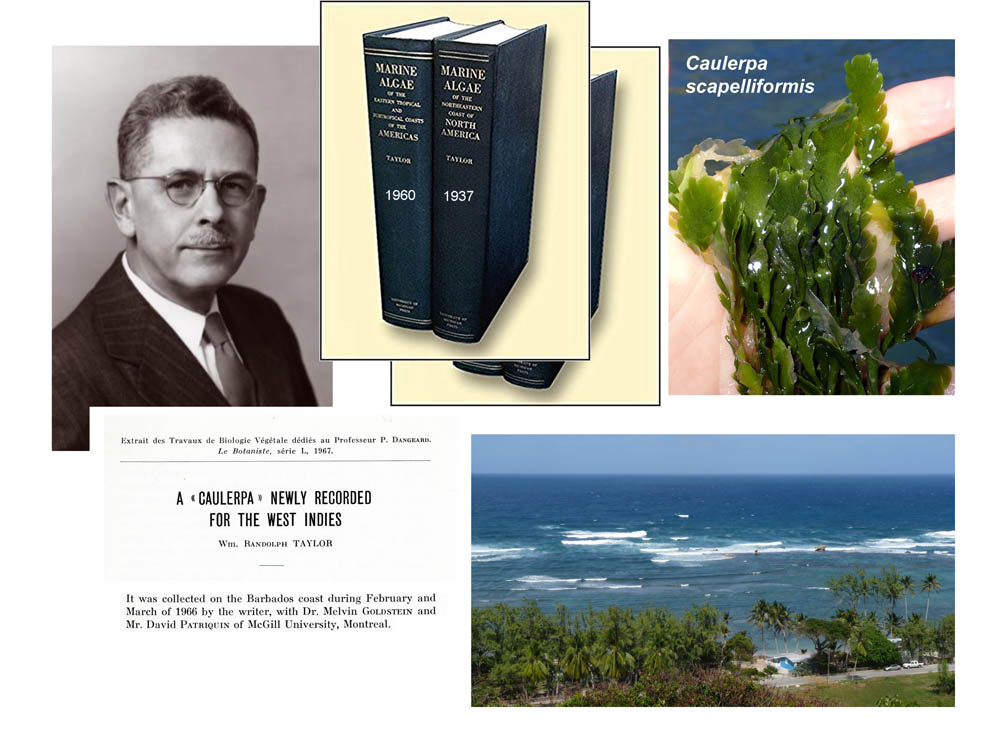
William Randolph Tylor. View Caulerpa paper
As mentioned by Brathwaite et al., there is an abundance of seaweeds at Bath – and they are accessible. Taylor, a prominent author of papers and books on seaweeds, often collected seaweeds washed on shore on the east coast; Bath was one of the few areas where specimens could be collected directly.
At the time and until a decade or so ago, there were also at Bath, “seagrass beds” – raised accumulations of sediment held together by seagrasses. (Seagrasses are rooted flowering plants that can grow in salt water.)
Those beds have now (2024/25) been largely overturned and dispersed and there are only a few small remnants of seagrass still hanging on.
It has been my fortune (or ill-fortune) to have documented (i) the occurrence of thriving seagrass beds at Bath over the period 1968 to 2011* (ii) subsequent massive disruption of the raised seagrass “beds”, and by 2025, near-complete loss of seagrasses (3 spp) from the entire area.
There was some change and some loss of seagrass over the period 1968 to 2011, but such loss would not be noticeable to most. The subsequent change was stark and would be striking to a visitor with goggles in 2025 had he/she visited the area in 2011 and earlier.
The documentation consists of (i) formal surveys and some photographc documentation in 1969, 1994 and 2015 ; and (ii) informal, photographic documentation of the state of the seagrass beds in 2005, 2011, 2024 & 2025. For more details see Context of seagrass observations at Barbados & Carriacou 1969 to 2025.
__________________________________________________
OTHER STUDIES OF THE BATH SEAGRASS BEDS
*In Chapter 5 of her 2000 thesis on”Changes in growth and abundance of seagrasses in Barbados, West Indies“, Lotus Vermeer reports on changes in seagrass occurrence and biomass at Bath between 1969 and 1994 and provides some interpretation/explanation of the changes.
There are also these studies conducted at Bath or that included components at Bath by McGill students (Supervisor Prof Frédéric Guichard):
– Influence of acute and chronic disturbance on macrophyte landscape zonation**
PDF
Tewfik et al., 2007 in Marine Ecology Progress Series
ABSTRACT: Although the roles of physical disturbance and successional recovery from such disturbances in structuring natural communities are well known, recent studies have begun to uncover the potential for alternate outcomes or climax states in a number of systems. Here, we examine the distribution of tropical macrophytes at a site with heavy wave exposure and explore equilibrium (microhabitat) and non-equilibrium (patch-dynamic) hypotheses to explain the observed pattern. The existence of a large and distinct zone of prolific macroalgae, undescribed 30 yr earlier, situated between 2 zones with a relatively high abundance of seagrass, challenges the classic successional regime within Caribbean macrophyte beds. Significantly smaller mean size and lower frequency of acute disturbances within the macroalgal-dominated zone, as compared to the outer, mixed macrophyte zone, appears to contradict the highly disturbed environment of classic colonizers. The dominance of macroalgae in the mid-shore zone may be enhanced by the presence of large sediment sizes that are accumulated through the effect of chronic wave stress. Potential causes of overall changes in the hydrodynamic forces at the study site include rise in sea level, increased wave exposure and associated erosion of reefs protecting the coast. We propose a model of macrophyte bed development and distribution that includes the important chronic ‘stress’ category of wave energy and potential dominance by macroalgae. Increased average wave energy can impose an elevated level of stress leading to modified patterns of macrophyte distributions and changes in the deterministic endpoint of the successional sequence.
**About this paper, which I first read in 2015 as I was conducting my repeat survey at Bath, I wrote Prof Guichard: “I was impressed with the interpretations in the Tewfic paper, given the limited study. There is one misconception which is the reference to “The existence of a large and distinct zone of prolific macroalgae, undescribed 30 yr earlier“… There is reference to such an assemblage in Patriquin (1975), although brief, on page 170 (“..a region of dense rhizophytic algal (Avrainvillea rawsonii and Halimeda opuntia)…”; (there is also some description to this community in my 1971 PhD thesis, but it’s buried in the appendix). However your general assumption that Avrainvillea spp have been increasing is borne out by my more detailed surveys over time.” Prof Guichard commented in reply: “Thanks for your email, and my apologies for missing your description of extensive algal cover at Bath…As you mentioned, it was a limited study, and we at first never meant to pursue a longer term research program in that system… We have seen major changes in the seagrass-avrainvillea cover at that site; the extensive cover we described in 2003 was almost completely gone last year, a trend that had started around 2011….”
– Patterns and effects of disturbance in Caribbean macrophyte communities
Alexander Tewfik, 2004, PhD thesis
– Successional dynamics in seagrass communities
Charalampos Mavromatis et al. 2006 in McGill Science Undergraduate Research Journal
– Density-dependent succession in Caribbean seagrass communities
Sandra Binning et al. 2007 in McGill Science Undergraduate Research Journal
————————
iNaturalist Project: Bath-Conset Bay Barbados: nearshore marine
Any posted observation within the prescribed area (map below) is recorded on this project

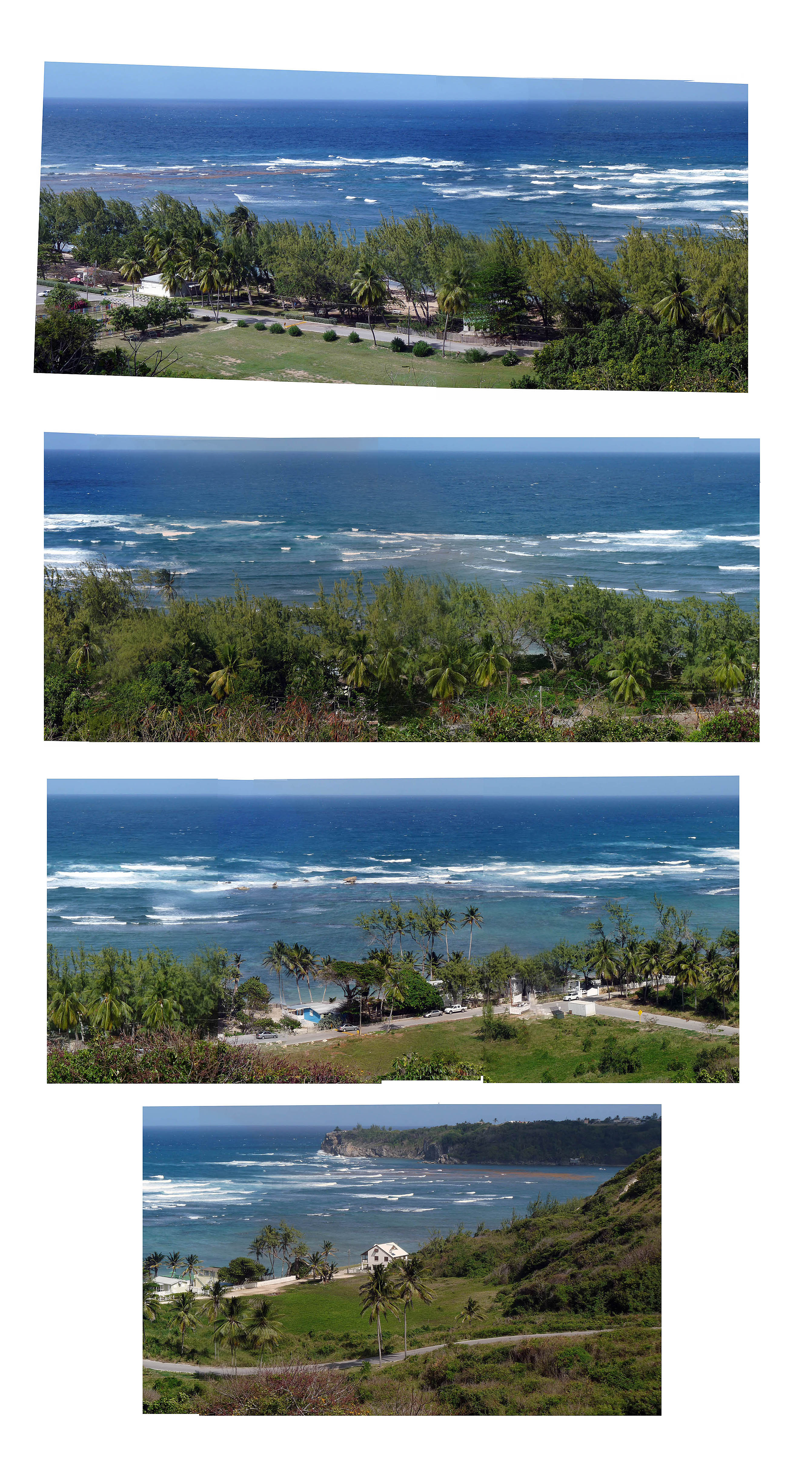
The Bath seafront as viewed from a hilltop in 2015.
View as single panorama
