
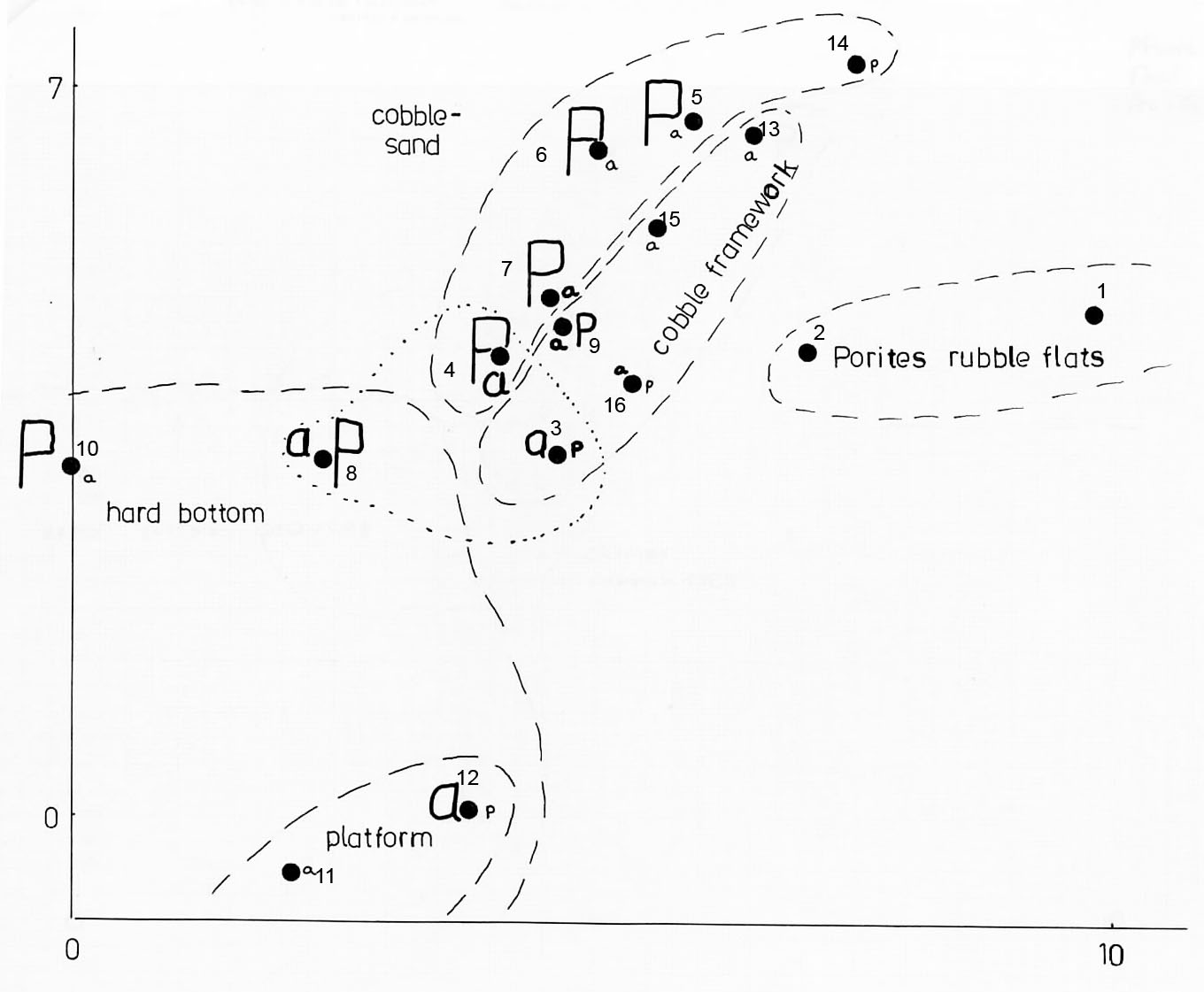
Ordination of the Bray–Curtis dissimilarity matrix for 16 Stations at Bath (1969 data). P=Porites furcata; a- Avrainvillea spp.; size of letter is proportional to frequency of occurrence in 12 quadrats. Envelopes enclose different bottom types. High abundance of Porites furcata and Avrainvillea spp tends to exclude or reduce the vigour of seagrasses and to bind the substrate. The central envelop is a perceived climax state common to Hard Bottom, Cobble-Sand (including Predominantly Sand) and Cobble Framework substrates. View Station Map. View 1969 Quadrat Data
As written up circa 1976:
A simple 2 axis ordination of the quadrat analysis data is illustrated in Fig.1 above.
X-axis ordination of these data corresponds to the postulated successional sequence, with the exception that there are two, rather than three distinct sequences; these are (i) a successional sequence on hard bottom, and (ii) a successional sequence on Thalassia-bound substrate. Stations (1) and (2) from the inshore PR flats do not seem to fall into either of these sequences – this is in accordance with other observations.
The Y axis ordination appears to correspond to a gradient in compositon associated with wave action. Direct measurements of wave action were not taken at these stations, however sediment mean particle size and sorting values, which are strongly influenced by wave action (free sediment samples only, not sediment bound in seagrass beds), correlate well with the y axis ordination. [Data to be added]
Efficiency of the x-axis alone is 41% and for both axes 67%. Use of a third axis resulted in no improvement in efficiency, and the groupings so obtained did not correspond to any of the remaining variables considered most influential (substrates, currents, depths). Thus the ordination suggests that successional development and wave action are the most important influences on community composition at Bath and of these, successional factors are about twice as influential as wave action.