“Snapshot 2025” of the Vauxhall Fringing Reef in Barbados 15Dec2025

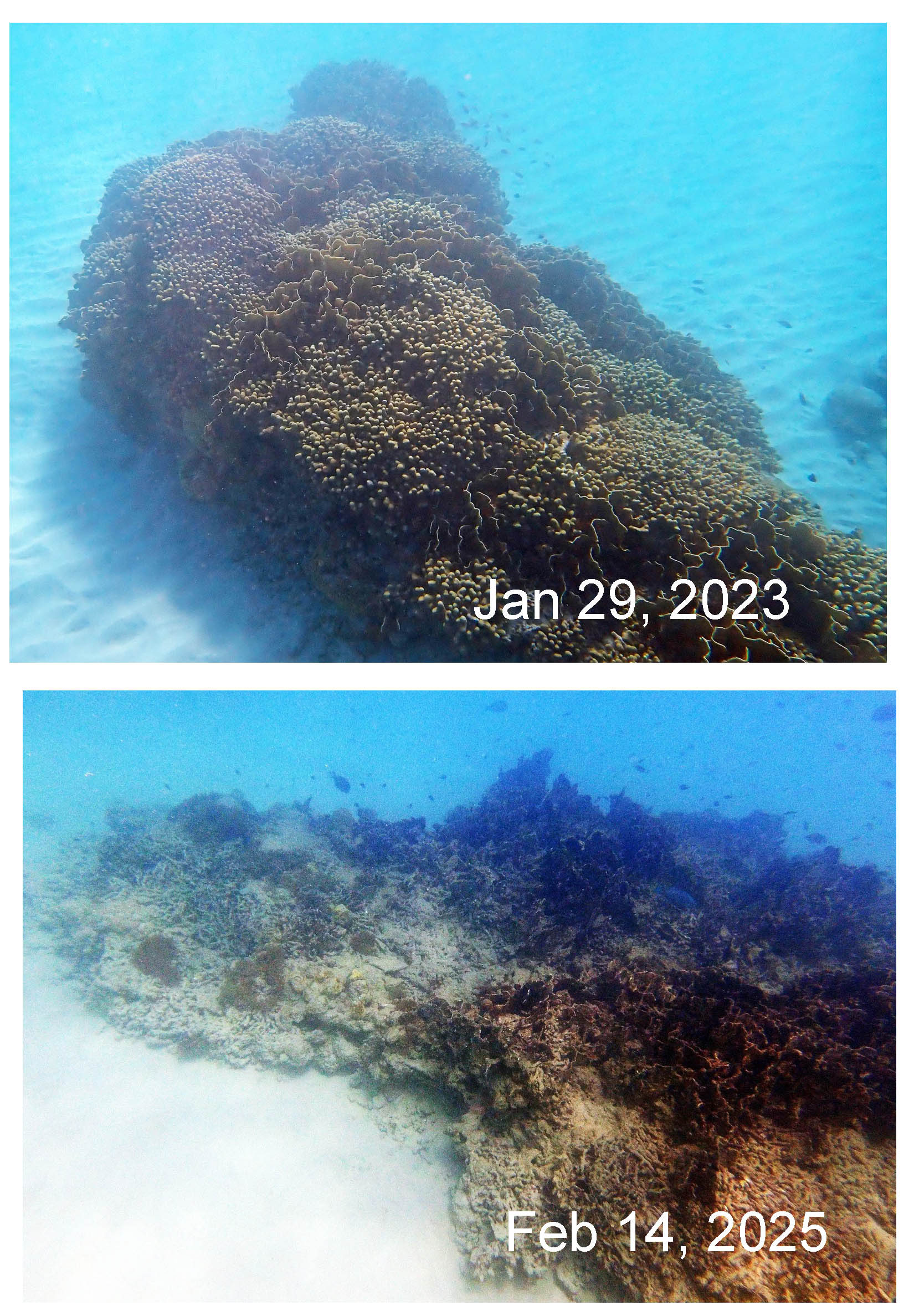
Top: Tip of spur at Vauxhall Reef in early 2023 >85% living coral.  Bottom: Tip of spur in early 2025: living coral cover <10%

I have observed, by snorkelling, the Vauxhall Fringing Reef in the MPA (Marine Protected Area) on the west coast of Barbados in the early months of each year from 2015 to 2020, and subsequently in the early months of 2023, 2024 and 2025.

In these “snapshot views”, recorded in photos and videos, Vauxhall reef was seen as very healthy, in marked contrast to other Fringing Reefs in the MPA.

Significant deterioration of Vauxhall Reef began in 2023 and continued through 2024 and 2025 – “The Years of Vicissitudes” – due to factors of external origin.

In early 2023, I observed the initial spread of SCTLD (Stony Coral Tissue Loss Disease) on the reef.

In 2024, I viewed the effects of extreme warming events in fall of 2023, those mostly on Acroporoid corals and on Millepora complanata (a “Stinging Coral”).

In 2025, I viewed the massive physical disruption of the outer spurs which had been 80-95% covered with living corals, this attributable to swells associated with Hurricane Beryl of June 30/July 1, 2024.
Read More

Posted in Barbados, Extreme Warming/Coral Bleaching, extreme weather, hurricanes, SCTLD, Vauxhall Reef | Comments Off on “Snapshot 2025” of the Vauxhall Fringing Reef in Barbados 15Dec2025

GCRMN issues “Status and Trends of Caribbean Coral Reefs: 1970-2024” 9Dec 2025

9th December 2025, Wider Caribbean Region – Coral cover in the Caribbean has declined by 48% since 1980 while macroalgae cover has risen 85% in the same time, according to a major new report by the Global Coral Reef Monitoring Network (GCMRN). The GCMRN, an operational network of the International Coral Reef Initiative (ICRI), found that these changes are largely driven by climate change-induced heat stress, overfishing, and diseases.”

Read More

Posted in Barbados, exotic species, Extreme Warming/Coral Bleaching, extreme weather, hurricanes, Invasive Species, Reef Health, Reef restoration, SCTLD | Comments Off on GCRMN issues “Status and Trends of Caribbean Coral Reefs: 1970-2024” 9Dec 2025

Extreme Weather cont’d in BIM 20Nov2025

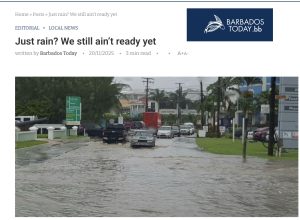
From Barbados Today, Just rain? We still ain’t ready yet posted Nov 20, 2025:

This past weekend offered Barbados a harsh and necessary wake-up call. A few intense hours of rainfall – focused largely on one side of the island – were enough to overwhelm roads, trap residents, claim the life of one man, and stretch our emergency services to the limit. It wasn’t a tropical storm. It wasn’t Hurricane Melissa. It wasn’t a system with a name.

…Sunday’s flood didn’t just expose weak infrastructure. It exposed a national mindset that remains dangerously reactive. Too many people still treat preparedness as optional, inconvenient, or something reserved for named storms. But climate change has removed the luxury of predictability. Extreme weather no longer waits for hurricane season, and danger no longer announces itself days in advance. Continue reading

Posted in extreme weather | Comments Off on Extreme Weather cont’d in BIM 20Nov2025

Warm-water coral reefs are crossing their thermal tipping point 15oct2025

Diagram illustrates that warm water coral reefs are the first of the global tipping points to be reaching tipping point temperatures. The authors comment that “Every tipping point of danger can be mirrored by a tipping point of opportunity. If coral reefs are dying back, restoration of coastal ecosystems can still drive
resilience and livelihoods.”
Click on image for larger version

From the Global Tipping Points Report 2025 issued at www.global-tipping-points.org, Oct 13, 2025:

“The world has entered a new reality. Global warming will soon exceed 1.5°C. This puts humanity in the danger zone where multiple climate tipping points pose catastrophic risks to billions of people. Already warm-water coral reefs are crossing their thermal tipping point and experiencing unprecedented dieback, threatening the livelihoods of hundreds of millions who depend on them. Polar ice sheets are approaching tipping points, committing the world to several metres of irreversible sea-level rise that will affect hundreds of millions.”


Posted in Extreme Warming/Coral Bleaching, Reef restoration | Comments Off on Warm-water coral reefs are crossing their thermal tipping point 15oct2025

“Gar” and “Garfish” in Barbados 4Oct2025

My curiosity about these fish began with a question about “houndfish”

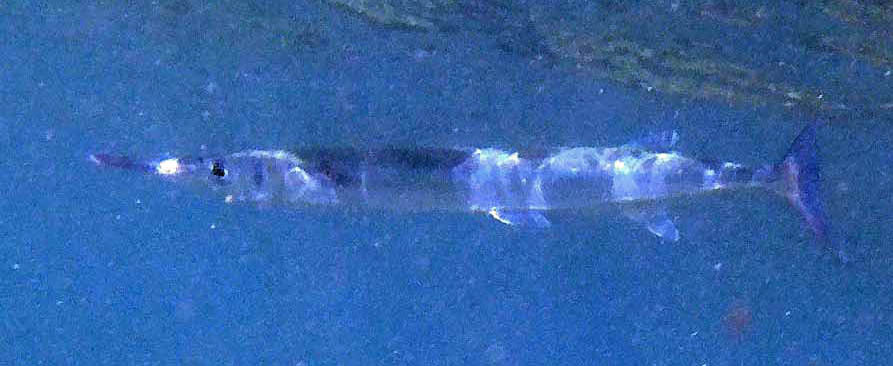
Observed Mar 5, 2025 near Reef Crest, in Barbados MPA. View iNaturalist record. iNaturalist member sue1001 disagreed with my ID of it as a redfin needlefish (Strongylura notata), commenting “[it’s a]” Houndfish Tylosurus crocodilus – [note] Shorter, thicker beak. No red/yellow fins. Nice find!”
Now I’m not so sure, only that it is a needlefish – or what Bajans call “gar” or “garfish”.
Click on images for larger versions

My interest in the category of fish caught in Barbados that are commonly called “gar fish” or “garfish” arose from a fish I had photographed and posted on iNaturalist, suggesting it was a redfin needlefish; a more knowledgeable iNat. member identified it as a houndfish (see pic at right). I have often seen groups of this fish – or a very similar species –  near the reef crest of fringing reefs in the Barbados MPA, but could not get close enough to them to get a really good image.

I was curious as to how common houndfish might be in Barbados.  I could find no references to “Houndfish, Barbados” on social media, so  I sent this message to spearfishingbarbados.com on Aug 31, 2025… Read More

Posted in Uncategorized | Comments Off on “Gar” and “Garfish” in Barbados 4Oct2025

Videos of healthy fringing reef at Vauxhall, Barbados 2015 to early 2023

In the early months of 2015, 2016, 2017, 2018, 2019, 2020, 2023, 2024 and 2025, I had the good fortune to spend a lot of time snorkelling on the fringing reef at Vauxhall, Barbados, camera in hand.

Up until early 2023, it was a healthy reef with overall high % coral cover and high coral diversity and an abundance and diversity of fish.  As such, it stood out from other fringing reefs in the Marine Protected Area which were (and still are) highly degraded.

Beginning in early 2023, Vauxhall Fringing Reef degraded significantly due to the arrival of Stony Coral Tissue Loss Disease, extreme warming/coral bleaching events, and extreme physical disturbance associated with Hurricane Beryl.

I have put together a set of videos to illustrate the overall healthy state of the Vauxhall Fringing Reef 2015 to early 2023.

View Healthy Fringing Reef Videos.

Posted in Barbados, Extreme Warming/Coral Bleaching, hurricanes, SCTLD, Vauxhall Reef | Comments Off on Videos of healthy fringing reef at Vauxhall, Barbados 2015 to early 2023

URGENT CALL TO ACTION TO CONSERVE AND RESTORE SHALLOW-WATER CORAL REEFS 24Jun2025

Continue reading

Posted in Extreme Warming/Coral Bleaching, Reef Health, Reef restoration, Vauxhall Reef | Comments Off on URGENT CALL TO ACTION TO CONSERVE AND RESTORE SHALLOW-WATER CORAL REEFS 24Jun2025

Boergesenia forbesii, a recent immigrant to Barbados? 26Mar2025

IN SHORT…

To date, photos of a green alga from Barbados uploaded to iNaturalist that appear to be Boergesenia forbesii have commonly been identified as Valonia utricularis (some gaining Research Grade status), or a species of Ulva or Caulerpa. A suggestion that a specimen I had identified as Valonia sp. was in fact a species of Boergesenia prompted my investigation of this topic.

The Conclusion: Overall, reports in the literature and iNaturalist records suggest that the earliest occurrence of Boergesenia forbesii in the Caribbean was in Puerto Rico (2008 reported collection date), and that it has spread southward reaching Barbados sometime between 2008 and 2016.

Of Indo-Pacific origin, Boergesenia forbesii is clearly a recent immigrant to Barbados.

Read more in iNaturalist Journal

Posted in exotic species | Tagged | Comments Off on Boergesenia forbesii, a recent immigrant to Barbados? 26Mar2025

Pelagic Sargassum blooms may be associated primarily with atmospheric phenomena 24Mar2025

Sargassum at Bath, Barbados Apr 6, 2015

So argue Julien Jouanno et al., in An extreme North Atlantic Oscillation event drove the pelagic Sargassum tipping point, published in Nature Communications Earth & Environment published Feb 8, 2025.

Abstract (Bolding inserted)
The proliferation of pelagic Sargassum in the tropical Atlantic since 2011 is causing considerable health and economic concerns as large amounts of this brown alga arrive and accumulate in coastal ecosystems of western Africa and of the greater Caribbean Sea every year.

Continue reading

Posted in Sargassum weed | Comments Off on Pelagic Sargassum blooms may be associated primarily with atmospheric phenomena 24Mar2025

“No El Niño, no relief: January sets another heat record” 9Feb2025

Impact of extreme warming in the fall of 2023 on a Barbados coral. Above: Healthy A prolifera in the “Mother Colony” on Vauxhall Reff on April 3, 2023. Below the same A prolifera dead and covered with algae on Jan 12, 2024. No recovery evident in early 2025. The yellow zooanthid at left remains healthy, however.

So reads the headline for a Feb 7 post by Chris Hatch in the National Observer (Canada) Zero Carbon Newsletter.

…despite conditions that should have cooled things down, Earth hit its hottest January in recorded history.

We’ve been on a run of record-setting temperatures ever since June 2023 when global heating suddenly kicked up a gear. Scientists are still trying to figure out what’s happening — why the last two years were so inexplicably hot and 2024 broke through the symbolic figure of 1.5 degrees above temperatures before the industrial revolution. The worry is that all this fossil fuel burning has unleashed an unexpected step change in the climate system.

Continue reading

Posted in Acroporoids, Extreme Warming/Coral Bleaching | Comments Off on “No El Niño, no relief: January sets another heat record” 9Feb2025