
DRAFTING..
|
The Marine Benthic Algal Flora of Puerto Rico Recent Smithsonian documents on The Marine Benthic Algal Flora of Puerto Rico provide up-to-date, well illustrated guides to marine algae which should apply – I am guessing – to 95% or more of the species to be found in Barbados. The graphic to the right of each ref. below provides a brief description of each one, copied from the URLs given for these documents (which can be slow to view). A download link is given for each doc.
|


Two books I have been relying on:
– Marine Plants of the Caribbean. A field guide from Florida to Brazil. 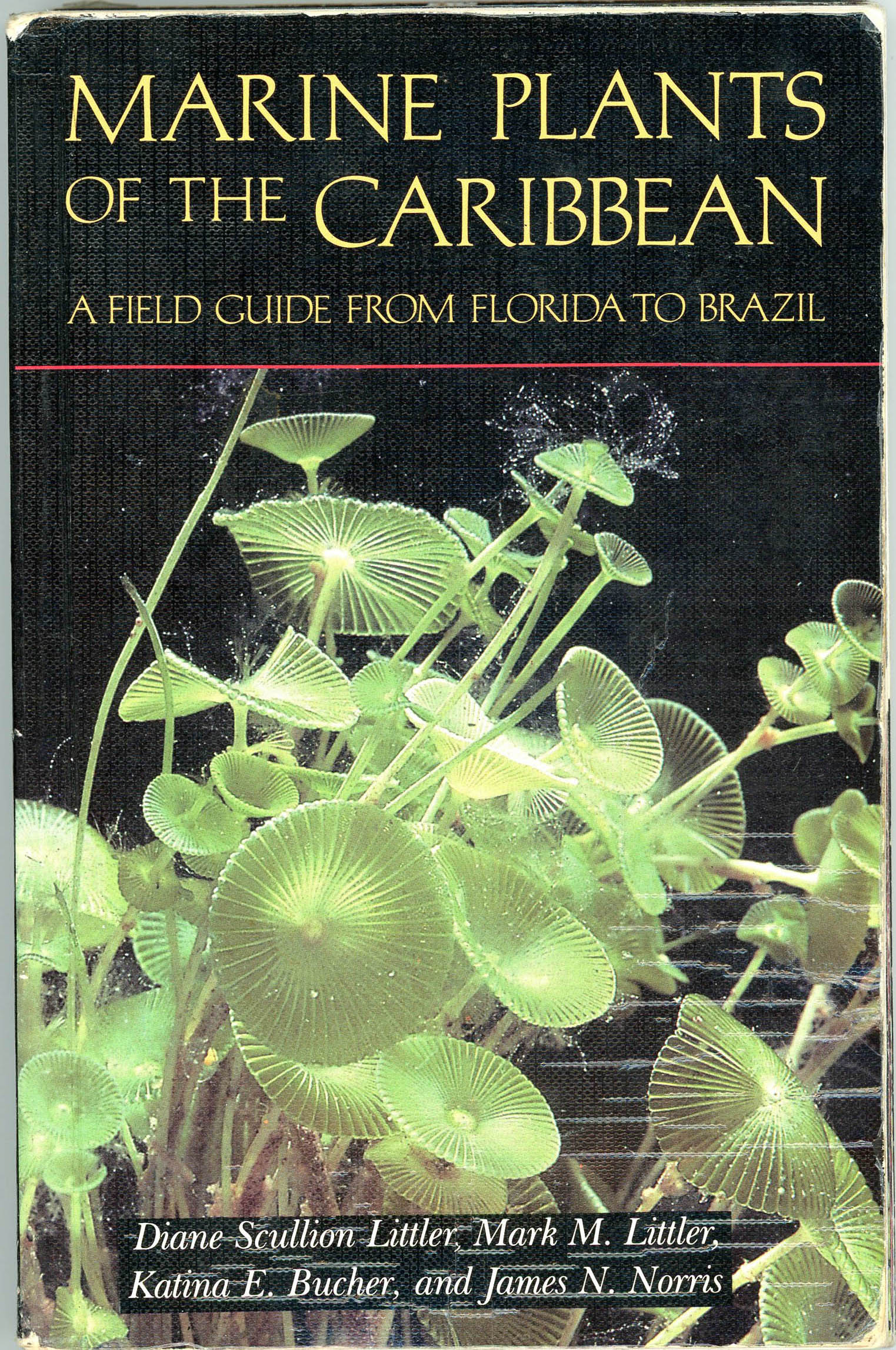 D.M. Littler, M.M Littler, K.E. bucher & J.N. Norris. Smithsonian Press 1989. 263 pages From Review by XXX: “This colorful little book is the type of field guide that is desperately needed by all those who are interested in observing or studying the great diversity of plants and animals that inhabit the shallow tropical seas, particularly around coral reefs…One word of caution: As the authors point out, this book covers the more abundant Caribbean marine plants, which account for only about one-third of the known species of this area. Users must therefore avoid making hasty identifications when they find a species that seems to resemble one in the book.”
– Caribbean Reef Plants
by Diane Scullion Littler & Mark Masterton Littler, April 1, 2000 Offshore Graphics Inc
From Review: Caribbean Reef Plants is the most useful marine plant identi®cation guide to be published since William R. Taylor’s tome, Marine Algae of the Eastern Tropical and Subtropical Coasts of the Americas, in 1960 -Taylor 1960). Although more limited in geographic and species coverage, it is far superior to this work for the nonspecialist. The book includes over 560 species of marine plants, including 7 species of seagrasses. The superb and wonderfully reproduced color photographs are at just the right scale to allow identification at a glance for most species. These capture the beauty, complexity, and relationships of the marine algae as no other book has…Regardless of future name changes, the details and illustrations of each species allow for more accurate identi®cations than previous guidebooks.
I “grew up” on Taylor’s 1960 tome*, so Littler & Littler (2000) has served as a good successor. Now with the Smithsonian docs available with up-to-date (2021-2026) taxonomies, those can be substituted, and they are fully available online,
* Marine Algae of the Eastern Tropical and Subtropical Coasts of the Americas.Taylor WR, 1960. Ann Arbor: The University of Michigan Press.
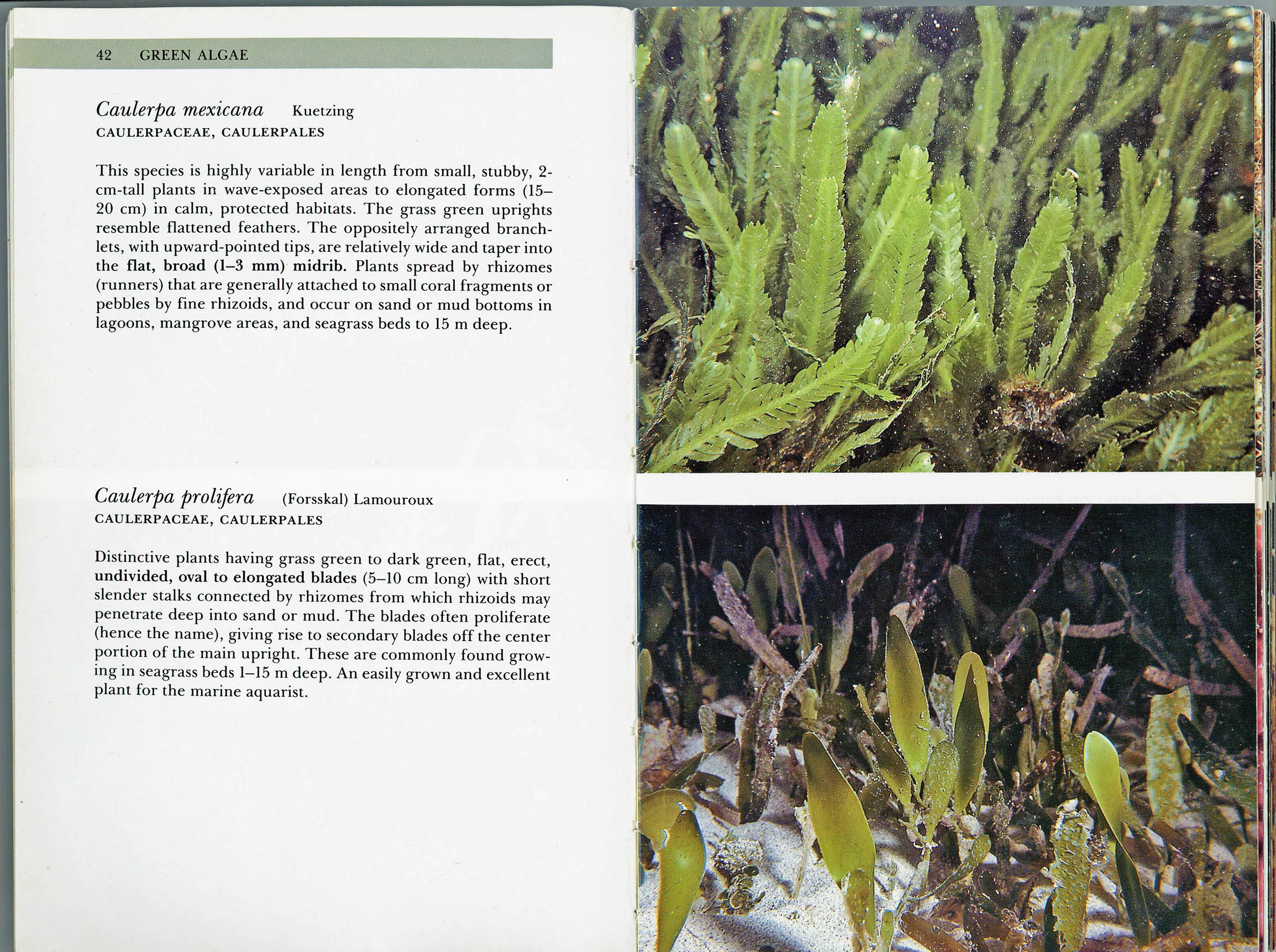
Marine Plants of the Caribbean opened at pp 42-43, two species of Caulerpa
A good combination, i suggest: Refer to Marine Plants of the Caribbean to get an initial ID, or at least a sense of what genus an algal specimen might belong to. (This book is still available as a used book at reasonable cost and is convenient (size & wt) to carry as a field guide). Go to the Smithsonian docs to refine the ID. (iNaturalist right now is not very helpful for ID of tropical seaweeds except for the most common species).
A checklist of the benthic marine algae of Barbados, West Indies
Michael Wynne, Tammy Bradshaw, C. M. Sean Carrington 2014 in Botanica Marina Request a PDF of the publication
“An updated checklist of the benthic marine algae (seaweeds) of Barbados, Lesser Antilles, is presented, with a total of 308 taxa, consisting of 168 taxa of red algae (Rhodophyta), 49 taxa of brown algae (Ochrophyta), and 91 taxa of green algae (Chlorophyta). Current nomenclature is provided…”
– Checklist of benthic marine algae of the tropical and subtropical Western Atlantic: fifth revision
Michael J. Wynne: 2022. 180 pages, 2 tables, 17x24cm, 530 g Language: English (Nova Hedwigia, Beihefte, Beih. 153). Request from Author
– Distribution and sexual reproduction in species of Caulerpa in Barbados
MSc thesis, McGill, 1968.
Abstract
A study, dealing with distribution and sexual reproduction of a tropical marine alga, Caulerpa, was conducted in Barbados, West Indies. An annotatèd list of all the species, varieties, and forms of Caulerpa known for Barbados, was prepared, and their distributions were mapped. The plants were grouped according to habitat type, with emphasis placed on environmental factors such as substrate and wave action. The process of sexuel reproduction was described for six species and includes information on gamete formation, gamete “pairing” and fusion, and zygote formation.
– Notes on the distribution of West Indian marine algae particularly in the Lesser Antilles
W. Taylor. 1969. In Contributions from the University of Michigan Herbarium 9(2) pp 125-203, 26 text-figures, 8 plates
– Systematics of Avrainvillea (Bryopsidales, Chlorophyta) in the tropical western Atlantic
DS Littler and MM littler. 1992. In Phycologia