
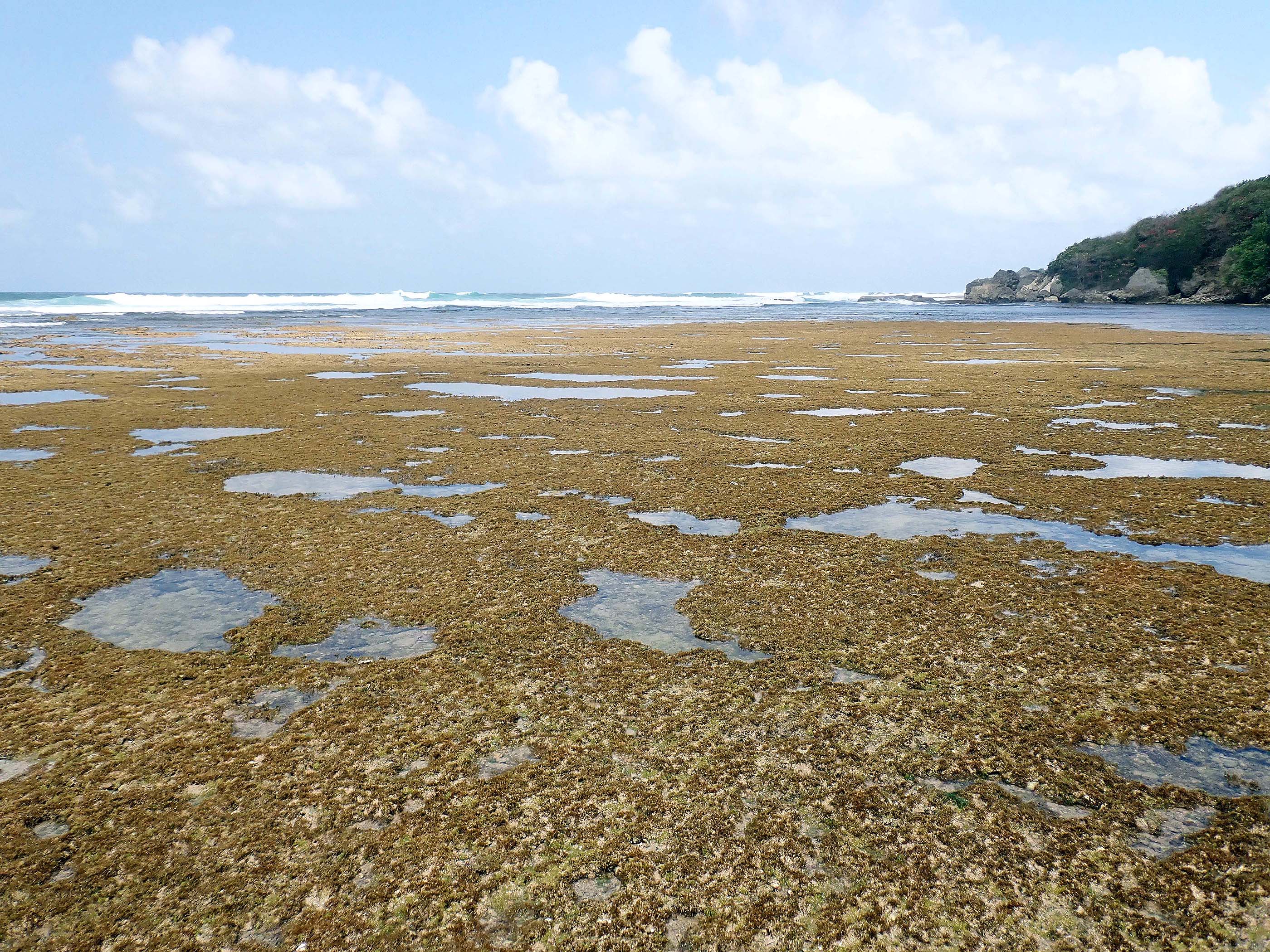
Coral Rubble Flats at Martin’s Bay, Mar 1, 2025
“Coral Rubble Flats” occurred in shallow water areas exposed on the lowest tides at Bath in 1969, and were still present in, superficially at least, the same condition and location in subsequent years up to my last visit to Barbados in 2025.
These flats have irregular, hard, surfaces in which the rubble constituents are firmly bound/cemented together.
I remember them in the late 1960s as sites where the seaweed Gracilaria deblis was harvested to make “seamoss jelly” – Mel Goldstein, my PhD co-supervisor (with John Lewis) wrote a paper on the topic.
Coral Rubble Flats similar to those at Bath occur elsewhere on the east coast of Barbados: Lewis (1960) referred to them as “extensive reef flats”:
Extensive reef flats, 100 to 200 meters wide, front sand beaches and escarpments of the windward coast. These are formed of coral rock. They are covered by about a foot of water at mean low tide and are sometimes exposed along their inner edges at low water spring tides. A heavy cover of attached Sargassum sp. is present along the outer edge and the flats are subject to heavy wave action, for at high tide long “rollers” pour over it continuously.
A few species of corals are found on the flats. At the inner edge around the bases of holes and tide pools small colonies of Porites divaricata, Siderastrea radians, Favia fragum, and Porites astreoides occur. – from p 1141 The Coral Reefs and Coral communities of Barbados, W.I., by J.B. Lewis in Canadian Journal of Zoology 38(6): 1133-1145, 7 Plates
Surely the most spectacular are those at Martin’s Bay (in the pic above) which I was lucky enough to visit on a low spring tide on Mar 1, 2025. While there has been a lot of “reef degradation” in Barbados, these reef-like flats appear to continue in good health, actively growing and protecting the coast.
View more pics and More about the Coral Rubble Flats.