
NAVIGATION
In the News is a top-level page on the website
Barbados Fringing Reefs & Seagrass Beds
Natural History Perspectives of a Visiter
Also view posts on the Home Page
Apr 30. 2026:
Could Underwater Autonomous Robots Save Coral Reefs?
Ryan Hesketh in https://www.smithsonianmag.com “Reef restoration is a slow process, with divers planting coral fragments one at a time by hand. But roboticists are now developing automated planters that could change the game…Given the slow pace of reef restoration projects, the math just “doesn’t math,” says Ian Enochs, the coral program lead at the U.S. National Oceanic and Atmospheric Administration’s Atlantic Oceanographic and Meteorological Laboratory in Florida. But researchers, including Enochs, think there’s a better way to secure corals’ future: What if, rather than coral reef rehabilitation remaining a tedious and difficult manual process, conservationists could harness robotics, artificial intelligence and autonomous vehicles to transform it into an industrial-scale endeavor? Robotics expert Benjamin Moshirian, with the Australia-based Reef Restoration and Adaptation Program, is among those leading the charge. He’s spearheading the development of the Deployment Guidance System (DGS)—the world’s first automated underwater coral planter. “You could call it an ocean tractor,” Moshirian says.Attached to a vessel roughly the size of a fishing boat, a DGS can either be piloted by a crew or left to operate autonomously. A camera coupled with artificial intelligence identifies suitable planting sites. When it spots the right mix of conditions below—the right seafloor substrate, the right depth and the right water flow rate—a dispenser mounted to the back of the craft drops a ceramic plate bearing a coral seedling. The whole process takes about half a second, far quicker than any human diver.”
Related:
– Scaling Underwater Robotics in Barbados
by Jordanna Straker for www.undp.org/, Nov 1, 2024 “…2019: Idea Stage & Launch. In 2019, the UNDP Accelerator Lab for Barbados and the Eastern Caribbean hosted a regional Call for Solutions (CFS) in which it asked surrounding grassroot thinkers and shapers to submit innovative approaches to challenges in renewable energy, sustainable tourism, fisheries and waste management. One of the solutions received was titled “BlueBOT,” the brainchild of Barbadian innovator S. Antonio Hollingsworth and product of his company Bajan Digital Creations Inc. According to the submitted proposal, underwater robotics could be used in combination with deep Machine Learning (M.L.) and Artificial Intelligence (A.I.) to amass information that could form open datasets on nearshore coral reef marine species in Barbados…”
– Unlocking Ocean Innovation
By Veronica Millington & Jordanna Straker for www.undp.org/, Dec 18, 2025 “As many countries power forward towards attainment of the Sustainable Development Goals (SDGs), innovation is no longer optional; it’s essential. The recently developed Sustainable, Virtual AI Marine Prototype from the UNDP Accelerator Lab for Barbados and the Eastern Caribbean is more than a technological milestone; it’s a story of collaboration, creativity, and commitment to ocean sustainability…The AI-enabled prototype created with support from the Japan Cabinet Office uses frontier technology to label coral reef fish species that appear in Blue Bot’s videos, ultimately feeding into a marine training dataset and computer vision model used to form marine data visualizations. Together, this work contributed to a virtual tourism experience where viewers can digitally “swim” through coral reefs while learning about fish species. This model not only supports biodiversity monitoring but also opens new opportunities for immersive tourism experiences without adding pressure to fragile marine ecosystems, which is paramount to the sustainability of Caribbean marine tourism for the future.
Apr 28, 2026:
Dah Beach Ain’t Mine: The Quiet & Persistent Enclosure of the Barbadian Horizon
CrossRoads Barbados “In 1982, the island of Barbados was vibrating to a specific frequency. The Mighty Gabby’s “Jack” wasn’t just a road march contender; it was a manifesto. When Gabby sang, “Dah beach is mine,” he was responding to a very tangible threat: the idea that a physical and metaphorical person or entity—a “Jack”—could plant a flag in our sand and tell a Barbadian they didn’t belong. It was a battle cry for the “public-ness” of our most sacred resource – the beach. But here we are in 2026, and as I look at the changing face of our coastline, I am reminded that Gabby’s victory was only a temporary ceasefire. The new enclosure of Barbados is quieter, more legalistic, and far more permanent. It is no longer about one man named Jack; it is about a wall of concrete, a ministerial waiver, and an economic model that views the horizon as a luxury commodity…The “Hotel-tation” Economy: From Sugar to Sand. To understand why we are being “shunted inland,” we have to understand the historical loop we are stuck in. For three hundred years, the best land in Barbados was reserved for the export product: Sugar. The masses lived on the “marginal” lands, the tenantries, the rocky edges of the plantation. When sugar died, we didn’t truly decolonize our land use; we simply swapped one export crop for another. The new crop is “The Tourist Experience.” And just like the planter class of old, the modern developer requires the “frontage.” The logic of our current economic growth—which the government proudly points to as a success of the post-pandemic recovery—is built almost entirely on construction and tourism. But this is an extractive model. When we approve another multi-story resort that sits directly on the littoral zone, we are essentially re-establishing the plantation boundary. The “Great House” has become the “Luxury Suite,” and the Barbadian is once again being moved to the periphery, permitted to enter the “front” only if they are wearing a uniform to provide labour. The Speightstown “Adjustment”: A Case Study in Pendry”…
Apr 1, 2026:
– The Barbados Fisheries Division – 82-years young!
Post on www.fisheries.gov.bb “April 1st, 1944 now feels like a distant twinkle on the ocean’s horizon, but will always be remembered fondly as the day the Barbados Fisheries Division officially opened its doors. Throughout the past 82 years, the Division has had the pleasure of supporting the food security of a Small Island Developing State (SIDS) by working closely with the island’s fishing fleet through its various evolutions…” The article provides a history of the Fisheries Division, changes in fishery and fish processing in Barbados over the years.
Mar 31, 2026:
– Progress on the Barbados Dolphinfish Tagging Program
Shelly-Ann Cox for Barbados Fisheries Division “March 27th saw the Barbados Fisheries Division’s third expedition out to conduct tagging on the dolphinfish (Coryphaena hippurus). The tagging program, in collaboration with the Guy Harvey Foundation, has allowed us to tag 16 dolphinfish to date. The journey of 100 dolphinfish tagged is well underway! Not sure what a tagged dolphinfish looks like? Be sure to look out for a thin, orange, antenna-like wire hooked on the shoulder of the dolphinfish, just above the pectoral fin…”
Mar 7, 2026:
– Spectacular images reveal unique sea creatures and corals off Caribbean islands
BBC by science reporter Georgina Rannard. “The waters off the glittering coastlines of Britain’s Caribbean territories have long been a mystery. But now scientists on the first expedition beyond the islands’ shallows have discovered an underwater mountain range, a massive “blue hole”, coral reefs apparently untouched by climate change and never-before-seen sea creatures. Operating 24 hours a day for the last six weeks, researchers subjected cameras and other equipment to extreme water pressure, recording as deep as 6,000m (19,700ft). To navigate the Cayman Islands, Anguilla and Turks and Caicos, they were forced to rely on decades-old maps with serious errors and whole areas missing. The UK Centre for Environment, Fisheries and Aquaculture Science (CEFAS) has shared their footage and discoveries exclusively with BBC News…On board the ship, CEFAS worked alongside a group of environmental experts from the Cayman Islands, Anguilla and Turks and Caicos who will use the findings to improve biodiversity management plans and find new fishing opportunities for island communities. “Our islands were literally born from the sea. But when it comes to our offshore environments, we really haven’t had a chance before to discover what’s out there,” Kelly Forsythe from the Cayman Islands Department of Environment told BBC News. The island governments joined the research as part of a project called Blue Belt Programme.”
Jan 13, 2026:
 We will reintroduce Stag horn corals to Barbados coral reefs
Post by Barbados Blue on FB “Our babies have grown so well over 2025. Soon they will be ready to be out-planted into the reefs. We will reintroduce Stag horn corals to Barbados coral reefs. Deeper and stronger to withstand hurricanes we hope. @eco_dive_grenada @marinebiologyposts @barbadosmarinemammals @marine_biology101 @coralreeffutures @coral_org @coralrestorationfoundation @perryinstituteformarinescience @reefrescuenetwork @padiaware @oceanahub_bb @visitbarbados @hiltonbarbadosresort @cocohillforest @spiritmas @caribbean_marine_biologist”
Dec 31, 2025:
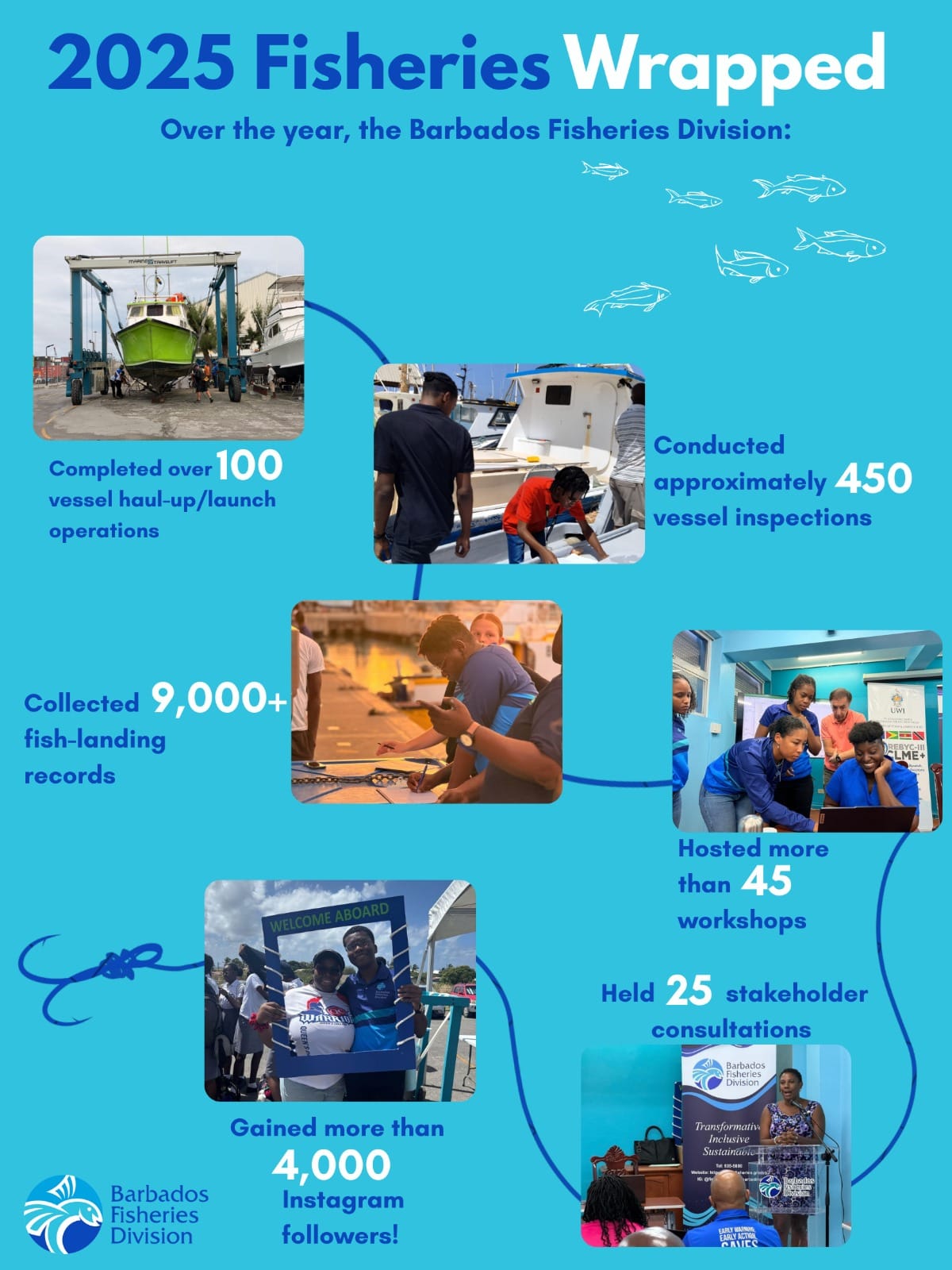 – Fisheries Wrapped: A 2025 Review
Barbados Fisheries Division. “As 2025 comes to a close, we are taking the time to look back at the milestones achieved throughout the year. Despite the many challenges faced, the year was filled with even more reasons to celebrate. Below are some of the major highlights throughout the year! Read More
Sep 2, 2025:
Catastrophic Coral Bleaching in the Caribbean – Now is the Time for a Regional Approach to Scale-Up Coral Restoration
Op-ed by Clear Caribbean on Caribbean Biodiversity Fund website. “Over the past two years, climate change has had devastating effects on coral reefs around the world. In the Caribbean, particularly the Windward Islands, sea temperatures were the hottest ever recorded at over 31C. The level of heat stress measured in Degree Heating Weeks reached 25, which according to NOAA translates as a “Risk of near complete mortality” from coral bleaching. Our restoration teams in St Lucia and St Vincent and Grenadines have been doing extensive surveys looking for elkhorn and staghorn survivors – and it’s not looking good. The sea has been too rough to survey the windward coasts, so we hope we will find some there when it is calmer. In our nursery in Saint Lucia, we have some surviving elkhorn and staghorn genotypes because we moved them into deeper water, but almost all our outplants and source colonies have died. To make matters worse, last year’s coral bleaching comes on the heels of the terrible SCTLD coral disease, Category 5 Hurricane Beryl, and the severe bleaching of 2023…we now need to do what many scientists are recommending and start moving corals from hot areas to cooler areas – it is called assisted migration.”
Aug 27, 2025:
– Without Data It’s All Just an Opinion: Citizen Science and Conservation in Barbados
By Kramer Wimberley, Founder of DWP-CARES & Reef Check EcoDiver Trainer for Reef Check “The vibrant underwater world of Barbados’ Carlisle Bay buzzed with purpose this past June, as a dedicated team of citizen scientists gathered for a week of intensive training in data collection efforts aimed at saving the coral reef ecosystem. This collaborative mission, a testament to the power of international partnership and shared environmental stewardship, brought together individuals from diverse backgrounds across the United States – California, New Jersey, Indiana, New York, Washington D.C., and Miami – united by a common passion for ocean conservation….”
Feb 9, 2024:
– Stronger Hurricanes and Climate Change in the Caribbean Sea: Threats to the Sustainability of Endangered Coral Species
EA Hernandez-Delgado et. al. 2024. Sustainability 2024, 16(4), 1506; https://doi.org/10.3390/su16041506 “An increasing sea surface temperature as a result of climate change has led to a higher frequency and strengthening of hurricanes across the northeastern Caribbean in recent decades, with increasing risks of impacts to endangered corals and to the sustainability of coral reefs.”
Oct 12, 2023:
– Coral Bleaching Alert
Barbados Fisheries Division “Due to recent high water temperatures it is predicted that bleaching is likely to occur over the next few weeks.” Also view Links: Coral Bleaching
Sep 12, 2023:
Newly deceased Caribbean reef-building corals experience rapid carbonate loss and colonization by endolithic organisms
Scientific paper by Medellin-Maldonado et al., 12 Sept 2023 in Communications Biology “Coral mortality triggers the loss of carbonates fixed within coral skeletons, compromising the reef matrix. Here, we estimate rates of carbonate loss in newly deceased colonies of four Caribbean reef-building corals. We use samples from living and recently deceased colonies following a stony coral tissue loss disease (SCTLD) outbreak. Optical densitometry and porosity analyses reveal a loss of up to 40% of the calcium carbonate (CaCO3) content in dead colonies. The metabolic activity of the endolithic organisms colonizing the dead skeletons is likely partially responsible for the observed dissolution… The dissolution rate depends on the relative abundance of coral species and the structural properties of their skeletons, yet we estimate an average reduction of 1.33 kg CaCO3 m−2, nearly 7% of the total amount of CaCO3 sequestered in the entire system.”
28-31 Aug 2023:
Recommended Strategies to Protect Parrotfish Populations in Barbados
Youtube video of presentation by Mr. Christopher Parker and Dr. Shelly-Ann Cox at CRFM Scientific Conference 28-31 Aug, 2023. Comprehensive, discusses negative and positive impacts of parrotfish in relation to the state of the reef (healthy, declining etc).
Aug 15, 2023:
Another avoidable danger for coral reefs
by Andrew Cohen in the Washington Post “In recent years, coral reefs in Florida and elsewhere in the Caribbean have been devastated by outbreaks of two waterborne diseases: stony coral tissue loss disease and an unnamed sea urchin disease caused by a newly described microorganism. The latter has eliminated more than 90 percent of the urchins from some sites; with the urchins gone, algae overgrow and destroy reefs. Both diseases spread partly through ballast water that ships take aboard to adjust buoyancy, and both were likely introduced to Florida and the Caribbean in ballast discharges.”
July 14, 2023:
Study shows coral affected by stony coral tissue loss disease can produce viable offspring
by PeerJ for phys.org,
May 19, 2023:
– In living colour – local action for coral reef restoration in Barbados
On UNDO: SGP The article features a phot0-essay by Courtney Forde, Volunteer and past Vice President of the Coral Reef Restoration Alliance (CORALL).
– Sargassum Studies Under Way To Seek Out Opportunities
Julia Rawlins-Bentham on gisbarbados.gov.bb May 19, 2023 “Barbados is currently undertaking studies to seek out new opportunities and ways to use Sargassum seaweed.
May 12, 2023:
Barbados Receives CREWS At Folkestone
Julia Rawlins-Bentham on gisbarbados.gov.bb . “Barbados has received a coral reef early warning station (CREWS) as part of a regional project entitled Enhancing Climate Change Resilience in CARIFORUM Countries. The country joins The Bahamas, Belize and Trinidad and Tobago in having the $139,000 station deployed in its waters, approximately one kilometre off the Folkestone Park and Marine Reserve in Holetown, St. James…Director of the Coastal Zone Management Unit, Dr. Leo Brewster, explained that the CREWS station was a met ocean buoy, which took meteorological data and examined environmental oceanographic parameters that were important for coral reef health. “The buoy is recording now. It sends up its data live. When we get the data we can put it on our website. We are actually building a website on our webpage www.coastal.gov.bb to allow the public to have access to the data,” he said. Dr. Brewster further outlined that the buoy would also provide information on the impact of runoff in the Holetown, St. James area, turbidity changes, and an opportunity for schools interested in environmental studies or geography to use the actual data information and integrate it into their own curricula and programmes, using live data.”
The 2022 Diadema antillarum die-off event: Comparisons with the 1983-1984 mass mortality
Alwin Hylkema et al., 2023, in Coral Reefs (Scientific Paper). “The 1983-1984 die-off of the long-spined sea urchin Diadema antillarum stands out as a catastrophic marine event because of its detrimental effects on Caribbean coral reefs…In late January 2022, a new mass mortality of D. antillarum was first observed in the U.S. Virgin Islands…By the end of April, the islands of Barbados, Martinique, the Dominican Republic and St. Lucia had reported mass die-offs of D. antillarum… The full extent of the 2022 D. antillarum die-off event is not currently known…Whereas the 1983-1984 die-off advanced mostly with the currents, the 2022 event has appeared far more quickly in geographically distant areas. First die-off observations in each jurisdiction were often close to harbor areas, which, together with their rapid appearance, suggests that anthropogenic factors may have contributed to the spread of the causative agent.”
Apr 6, 2023:
– Asst. Prof. Sarah Gignoux-Wolfsohn is Helping Develop Probiotic for Stony Coral Tissue Loss Disease
By Brooke Coupal for UMass Lowell, “Diving off the coast of San Andrés, the researchers will search for healthy corals among those infected by the disease and collect fragments to bring back to Gignoux-Wolfsohn’s lab. There, she will investigate what bacteria are abundant on the corals that are resisting the disease. “Any bacteria that is naturally more abundant might be helping those corals survive,” she says.” Related: Newly discovered probiotic could protect Caribbean corals threatened by deadly, devastating disease, by Smithsonian for phys.org, Apr 6, 2023. Article references this scientific paper: Chemical and genomic characterization of a potential probiotic treatment for stony coral tissue loss disease, by Ushiijma et al., 2023 in Communications Biology
Feb 2, 2023:
Scientists hope lab-grown coral can save endangered Florida Keys reef (video)
BY MANUEL BOJORQUEZ CBS Evening News Feb 2, 2023
Jan 13, 2023:
Protecting Tobago from Stony Coral Tissue Loss Disease
Prepared by: Hannah Lochan for www.ima.gov.tt, Jan 13, 2023. SCTLD had not arrived there yet; concersn about cruise ship ballast water expressed. Also view: Transmission of stony coral tissue loss disease (SCTLD) in simulated ballast water confirms the potential for ship-born spread Michael S. Studivan et al., 2022 in Nature.
Oct 31, 2022:
Spotting hopeful signs for coral health in Barbados’s backyard
Under WHERE I WORK in Nature 31 Oct 2022 “In his diving surveys, ecologist Henri Vallès is finding that some coral populations might be on the mend.”
May 13, 2020:
Heat-evolved microalgal symbionts increase coral bleaching tolerance
P. Buerger et al., 2020. Science Advances 13 May 2020: Vol. 6, no. 20, eaba2498 DOI: 10.1126/sciadv.aba2498 “Coral reefs worldwide are suffering mass mortalities from marine heat waves. With the aim of enhancing coral bleaching tolerance, we evolved 10 clonal strains of a common coral microalgal endosymbiont at elevated temperatures (31°C) for 4 years in the laboratory. All 10 heat-evolved strains had expanded their thermal tolerance in vitro following laboratory evolution…these findings demonstrate that coral stock with enhanced climate resilience can be developed through ex hospite laboratory evolution of their microalgal endosymbionts”
Nov 30, 2019:
Underwater Speakers Help Revive Dying Coral Reefs, Study Finds
Trevor Nace on www.forbes.com Nov 30, 2019. “A recently published paper in Nature Communications highlights research focused on the impact of playing sounds around dead or dying corals. The findings were a pleasant surprise in the future conservation and recovery of coral reefs.
Mar 21, 2019:
Researchers embrace a radical idea: engineering coral to cope with climate change
By Warren Cornwall in sciencemag.org Mar. 21, 2019 ,