
NAVIGATION
This page is a subpage of Successional Processes in Seagrass Beds
That page is a sub-page of ObsSG, a top-level page on the website
Barbados Fringing Reefs and Seagrass Beds (www.versicolor.ca/barbados).
Go to ObsSG for a list of other subpages in this section of the website.
DRAFTING…
Stages of Succession
In clearances or in recent muddy or sandy areas there is a micro-flora consisting of Oscillatoria, Microcrocis (Holopedia), Lyngbya (Cyanophyceae); Exuviaella, Thecadinium (Dinoflagellata); Amphora, Pleurosigma, Nitzschia and other diatoms as well as some higher, filamentous algae.
Among the microfauna ciliates are common (Condylostoma, Prorodon, Euplotes, Lacrymaria, Mesodinium) and also miliolids and other foraminiferans; rhabdocoelids, some small medusae; nematodes, rotifers (Seison), gastrotrichs; annelids; harpacticoids; tanaidaceans, ostracods (Cythereis, Cytherura), anfipods and other crustaceans. A sedimentivorous annelid (Arenicola?) makes large cones (50-60cm in diam.) that may cover 75% of the bottom surface in these areas.
Communities that follow the preceding are characterized by the invasion of a macroscopic flora composed mainly of Dictyota divaricata, D. cervicornis, D. bartareysii, Laurencia papillosa, Acanthopora spicifera, Chladophoropsis membranacea, Penicillus capitatus, Udotea labellum, Avrainvillea nigricans, Avrainvillea longicaulis. Valonia ventricosa and sometimes Acetabularia crenulata and the monocot Dipianthera Wrightii. The microflora and microfauna are similar to those of the preceding stage but the macrofauna is enrichened with sabellids, holothurians (Holothuria mexicana, Stichopus badionotus), Cassiopele, Astropecten, and sometimes Diadema and a black colored sponge. Some of these animals facilitate the formation of mud and thus accelerate succession. As an end product we have the final occupation by Thalassia.
The same end community may come into existence by passing through different stages.
Sometimes the polyps of Porites coral are suffocated by filamentous algal growth, after which Halimeda can take a hold and forms a thicket among the coral branches.
This community harbors a very diversified fauna, the greater bulk of which is composed of filtrating and sedimentivorous organisms (see below): sponges, tunicates. pelecypods, holothurians etc. To these, a varied concentration of ophiurans (Ophiothrix angulata, Opbiocoma echinata, Ophioderma appressa, Ophionereis reticulata, Ophiolepis paucispina, Ophioconella caribbasa); asteroids (Linkia guildingii); echinoids (Echinometra lucunter); brachyurans (Mithrax (Mithraculus] coryphe, Pilumnusdasypodius and caribbaeus, Macroceloma diplacantha, Chlorodiella longimana); stomatopn? (Gonodactylus oerstedii); anomurans (Petrolisthes galathinus), mollusks (see below) zoanthids; (Zoanthus sociatus); actinians (Stoichacfis helianthus) and annelids (Hesione protochona, Lumbrinereis floridana, Hermenia verruculosa, Lepidonotus notatus, Hermodice carunculata, Notopygo scrinita and occasionally Sabelastarte magnifica and various other Sabellids, Serpulids and Terebellids), ainpunculoids and even fishes (blennids) are added.
The dead coral branches are also encrusted by several algae (Peysonellia rubra, Raffsia expansa) and bryozoans.
The richness and diversity of the fauna is much greater in this series than in the one originating from a muddy substratum, In fact, it is a general rule that the benthos occurring over a relatively solid substrate contains a more mature community and is more diversified than that from muddy bottoms.
When an equivalent succession is established on a rocky bottom, the first step seems to be initiated by encrusting Rhodophyceae, followed by clumps of other, more bushy Corallinaceae and sometimes Padina. These fix the loose bottom particles and permit the entrance of a number of forms that would otherwise have stayed out. Among the rocks, a number of animals take hold: Echinometra lucunter; Diadema antillarum; Holothuria glaberrima; Ophiocoma echinata; the anemone Aiptasia (in quiet water); Zoanthus and Palyzoa (the latter in coral rock) hesionid and amphinomid annelids; sabellids and serpulids, the snails Livona pica, Astraea caelata and Purpura patula, the chiton Acantbopleura granulata etc, etc. The calcified segments of Halimeda and other Corallinaceae accumulate in the form of sand, slowly establishing the conditions necessary for the growth of Thalassia.
When the end Thalassia community is reached, the composition of the different series becomes more uniform. Diversity may come out again, however, during the various regressions caused by denudation of the bottom.
In the shaded, usually muddy belt of advancing mangroves, Penicillus, Udotea, Caulerpa taxifolia and crassifolia and Avrainvillea usually precede the mangrove, followed behind by Caulerpa verticillata, Thelepus, Sabellastarte, Aiptasia and other vegetable and animal forms of the mangrove bank. In places that are not as shaded (Phosphorescent Bay), Dictyota, Laurencia and Acanthophora make a fast appearance, while in sandy areas (Poza de Da. Eulalio), the association of Halimeda soon takes over.
The following is a comparison of the Mediterranean Posidonia meadows with the Thalasia community in Puerto Rico. [Diagram below shows only the “Thalasia community in Puerto Rico”]
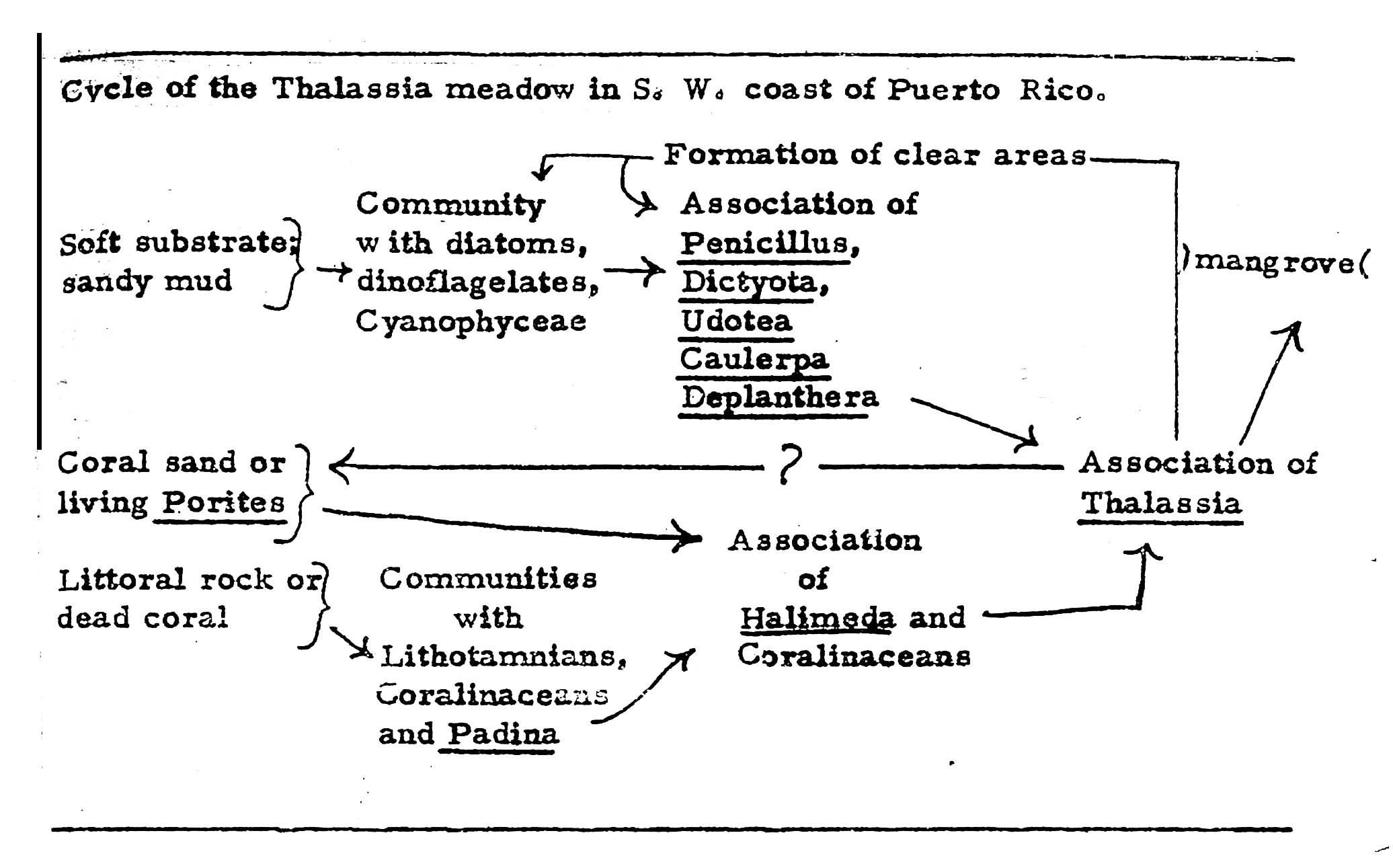
Source
Margalef, R. and Rivero, J.A. 1958. Succession and Composition in the Thalassia Community in Association of Island Marine Laboratories Second Meeting (1958), pp 19-21. PDF *
*A 12 page paper by this title and authors was in the library at Bellairs Research Institute in 1967; the extracts extracts above are from that document, but are not in the ref. above. The figure above is contained on page 8 of Liboy, J.G. 1979**, which he attributes to Margalef, R. 1962. Comunidades Naturales. Publicaciones Especiales, Instituto Biología Marina, Universidad de Puerto Rico, Mayagüez. 469 p. Also cited in Margalef, Ramón 1962. Succession in marine populations In Advancing Frontiers of Plant Sciences 2: 137-186; Preprint – see pp 11, 12
**Liboy, J.G. 1979. An Examination of the Present Condition of Seagrass Meadows in La Parguera, Puerto Rico FINAL REPORT State: Puerto Rico Project No.: F-4 Period Covered: July 1976 – June 30, 1979 Study No.: VIII Principal Investigator: José González-Liboy Study Objective: To describe the present condition of La Parguera’s turtlegrass habitat. 95 pages.