
| NAVIGATION This page is a sub-page of ObsSG, a top-level page on the website Barbados Fringing Reefs and Seagrass Beds (www.versicolor.ca/barbados). Go to ObsSG for a list of other subpages in this section of the website. |
SUBPAGES OF THIS PAGE – Bathsheba (photos) – Martin’s Bay (photos) – Frog Rock (photos) – Bath (photos) |
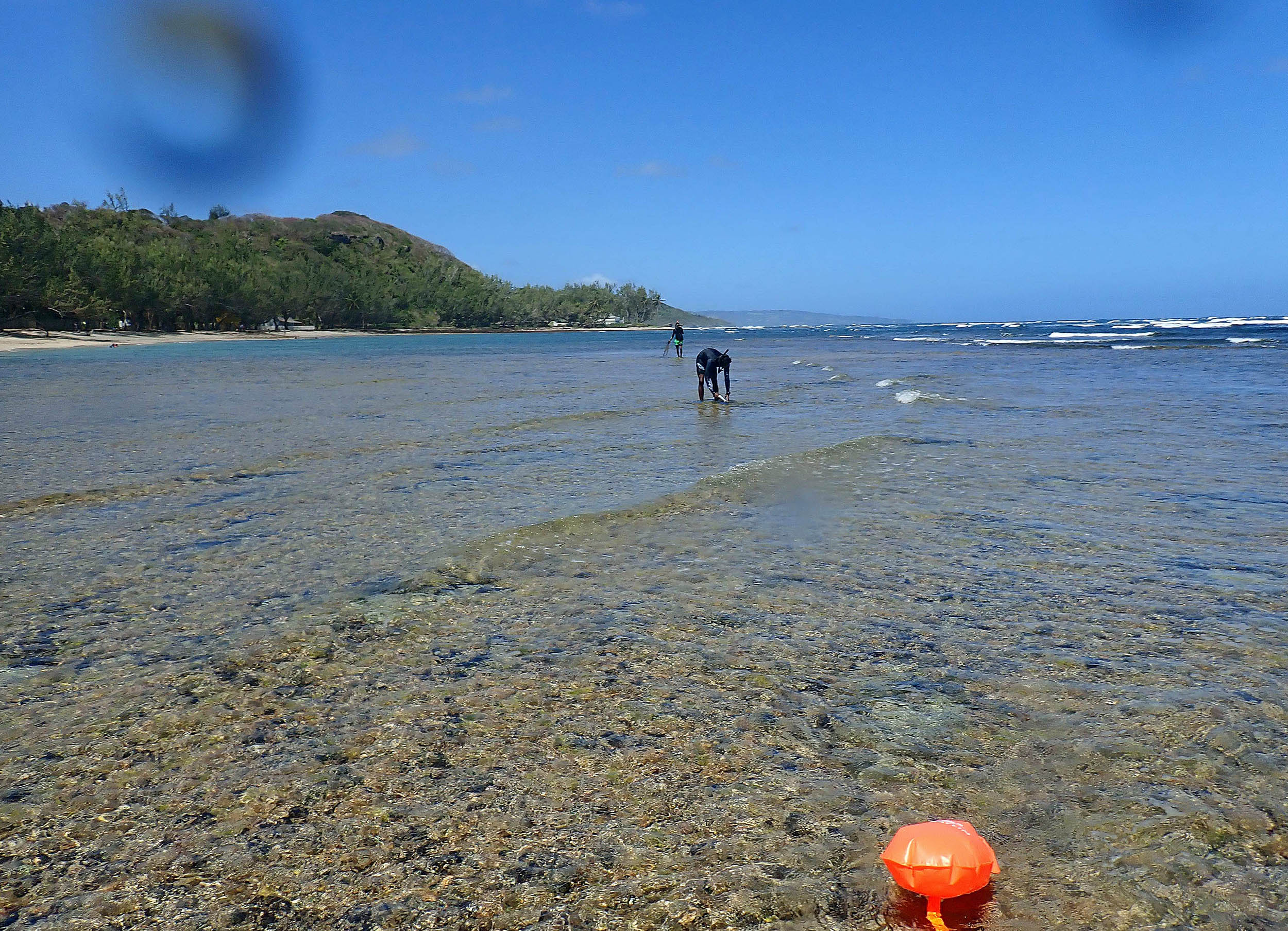
Coral Rubble Flat at Bath.
Click on images for larger versions
ON THIS PAGE
1. Coral Rubble Flats at Bath
2. Coral Rubble Flats on the East Coast
3. “Algal Pavement” & “Gorgonian Pavement” at Bath
4. Recent Photos
5. Name equivalents to “Coral Rubble Flats”
6. On the Nature & Binding of “Coral Rubble”
7. A note on “Beackrock”
1. CORAL RUBBLE FLATS AT BATH
“Coral Rubble Flats” occurred in shallow water areas exposed on the lowest tides at Bath in 1969, and were still present in, superficially at least, the same condition and location in subsequent years up to my last visit to Barbados in 2025. These flats have irregular, hard, surfaces in which the rubble constituents are firmly bound/cemented together. I remember them in the late 1960s as as sites where the seaweed Gracilaria deblis was harvested to make “seamoss jelly” – Mel Goldstein, my PhD co-supervisor (with John Lewis) wrote a paper on the topic.
Seagrasses are absent from the flats except for occasional occurrence of T. testudinum in tide pools within the flats, hence the Coral Rubble Flats were not identified as such in the Bath seagrass maps of Patriquin (1971, 1975).
The approx. areas of Coral Rubble flats and of “Algal Pavement” – likewise not identified as such on the original maps – are inserted as shown below:
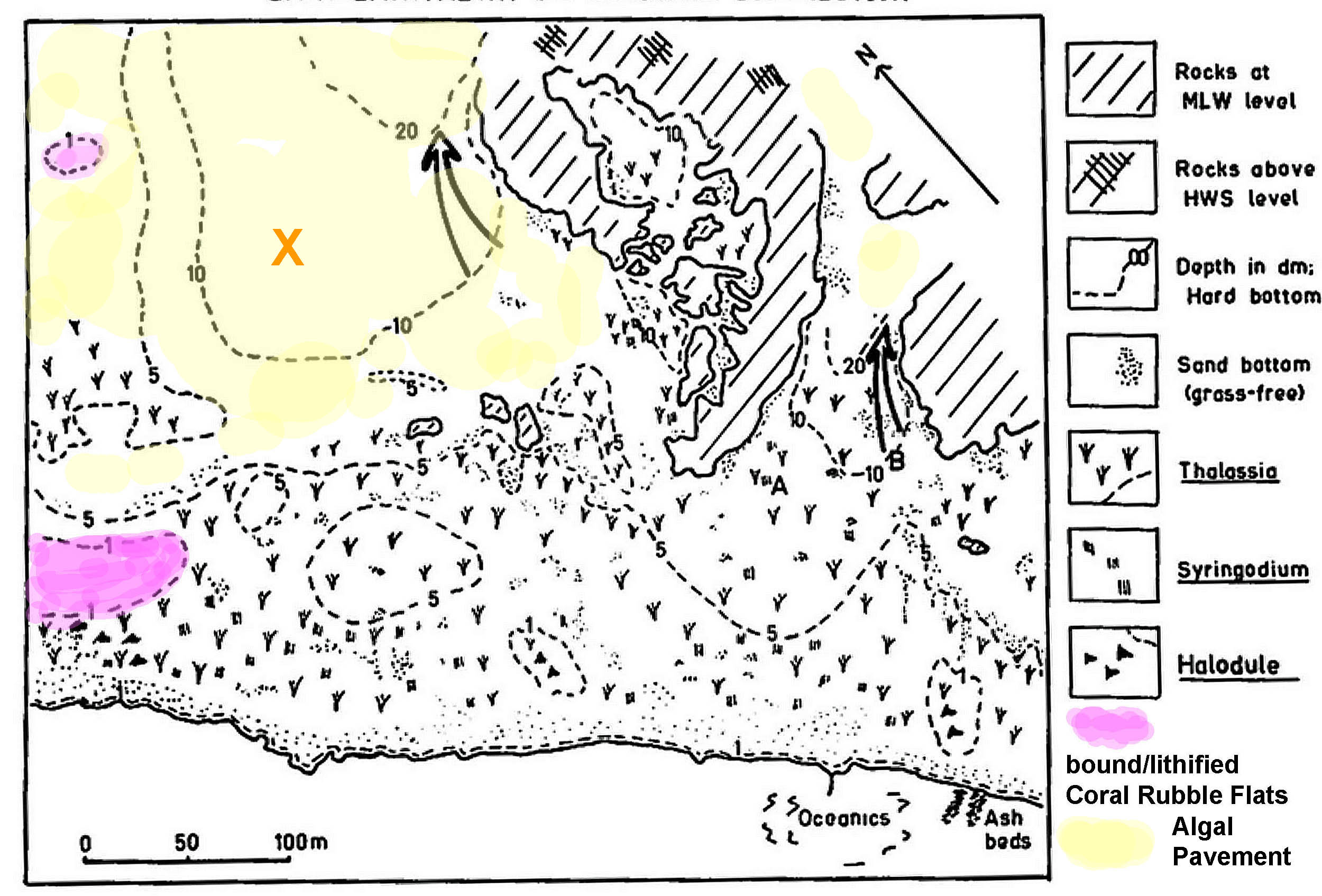
Map 1. Bathymetry and Seagrass Distribution at Bath (Patriquin, 1971, 1975), with areas of Coral Rubble Flats and Algal Pavement inserted (2026); X is the approx. location of a large colony of Acropora palmata, 5 to 7 m diameter, observed in 1994.
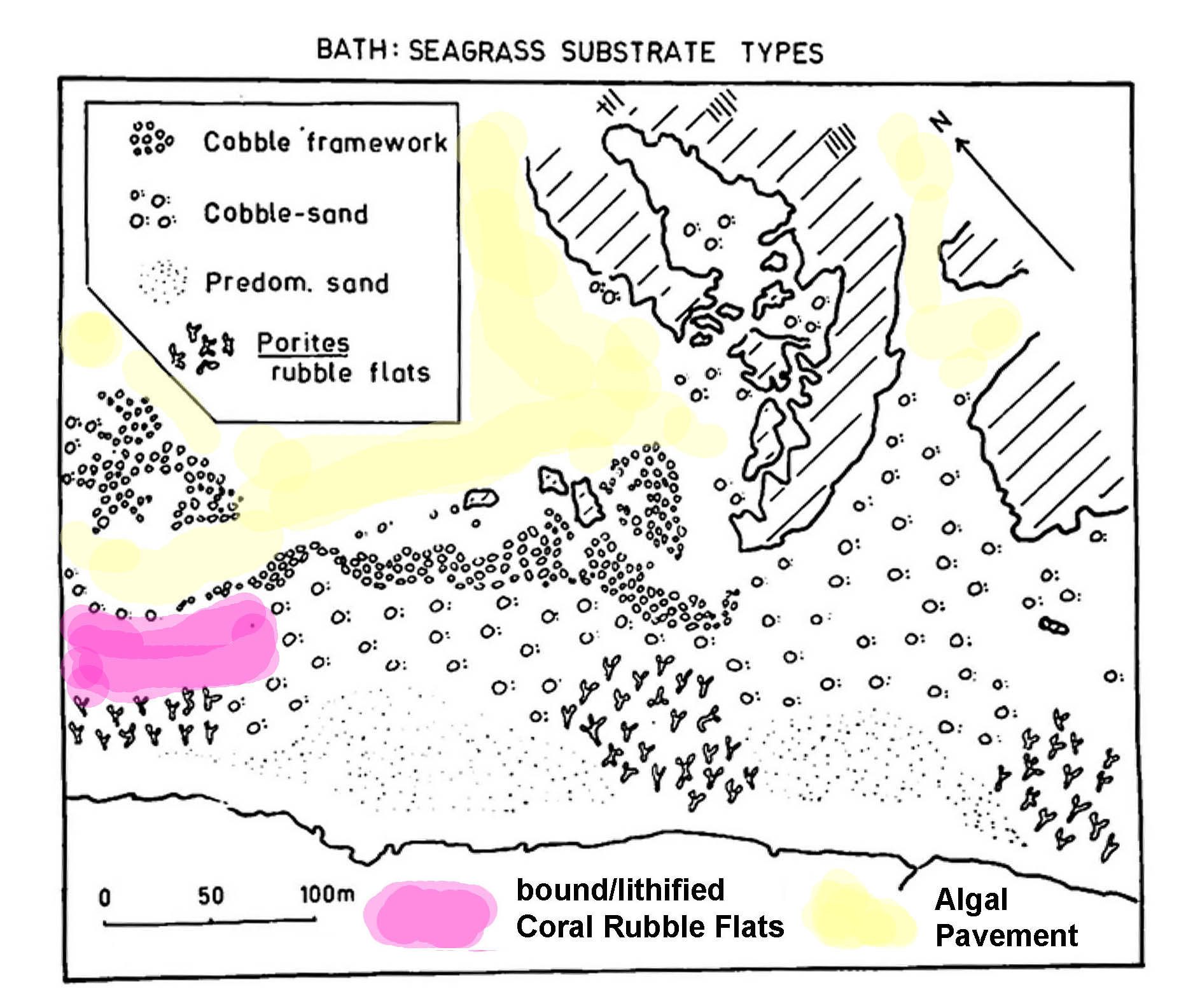
Map 2. Distribution of Seagrass Substrate Types at Bath (Patriquin, 1971, 1975), with area of Coral Rubble Flats and Algal Pavement inserted (2026).
Coral Rubble Flats similar to those at Bath occur elsewhere on the east coast of Barbados: Lewis (1960) referred to them as “extensive reef flats”:
Extensive reef flats, 100 to 200 meters wide, front sand beaches and escarpments of the windward coast. These are formed of coral rock. They are covered by about a foot of water at mean low tide and are sometimes exposed along their inner edges at low water spring tides. A heavy cover of attached Sargassum sp. is present along the outer edge and the flats are subject to heavy wave action, for at high tide long “rollers” pour over it continuously.
A few species of corals are found on the flats. At the inner edge around the bases of holes and tide pools small colonies of Porites divaricata, Siderastrea radians, Favia fragum, and Porites astreoides occur. – from p 1141 The Coral Reefs and Coral communities of Barbados, W.I., by J.B. Lewis in Canadian Journal of Zoology 38(6): 1133-1145, 7 Plates
3. “ALGAL PAVEMENT” & “GORGONIAN PAVEMENT” AT BATH
Beyond the seagrass at Bath and leading out past “The Platform” (Rocks at MLW level and Rocks above HWS in Map 1 above), is hard bottom; it was mapped by Brathwaite & Oxenford (2008, p. 36) who described it as “Algal Pavement” extending in deeper water to “Gorgonian Pavement”.
The powerful, rolling ocean waves and crashing breakers of the east coast provide a high energy and formidable undersea environment. These waves, coupled with continued re-suspension of eroded clays brought down by rivers from the Scotland District, mean that few corals exist anywhere offshore between Bathsheba and Gay’s Cove. At Cattlewash and Bathsheba huge boulders of Pleistocene limestone, the work of long dead corals, take a battering in the breaker zone. Further south at Bath and Conset, a shallow coastal lagoon is protected on its seaward side by a reef crest made up of coral rock boulders, supporting a few colonies of fire coral, brain corals and an abundance of macroalgae. Beyond this and stretching some distance offshore is an algal and gorgonian pavement. -In Barbados : a coral paradise by Angelique Brathwaite. & Hazel Oxenford Ramon Roach Publisher: Miller Publishing Co. Ltd., Barbados, 2008
The Algal Pavement extending in deeper water to the Gorgonian Pavement of Brathwaite & Oxenford (2008) seems to correspond location-wise to benthic habitat classified as “Mixed Reef Hard Ground” by Baldwin et al., (2019):
Name: Mixed reef hard ground. Code: MRHG. General Description: Usually on flat pavement with sand veneer or rubble. Diverse dense community – usually gorgonian or seafan dominated but other classes (hard coral, sponges, macroalgae) may be equally or almost as dominant. – In Developing a benthic habitat classification scheme and island-wide map for Barbados based on remote sensing and comprehensive ground-truthing by K. Baldwin et al., 2019. CERMES Technical Report No. 94
Lewis (1960) provides this description”
| Along the outer edge of the flats the water deepens to 8 to 10 ft or drops sharply to about 60 ft. Vertical sides are thus formed which face directly into the prevailing wind. Strong alongshore currents prevail and the water is heavily laden with sediment. Visibility is limited to less than 10 ft during most of the year. The vertical faces are deeply undercut with deep caves penetrating far into the rock and large block and debris falls are found at their bases.
The most characteristic feature of the zone seaward of the reef flat is the complete absence of branching corals. Furthermore, the massive species I such as Montastrea, Siderastrea, and Diploria do not form rounded heads but are encrusting and flattened. At the outer edge of the reef, from depths of 8 or 10 f t to 60 ft, and 011the sides of the vertical walls, the following species occur: |
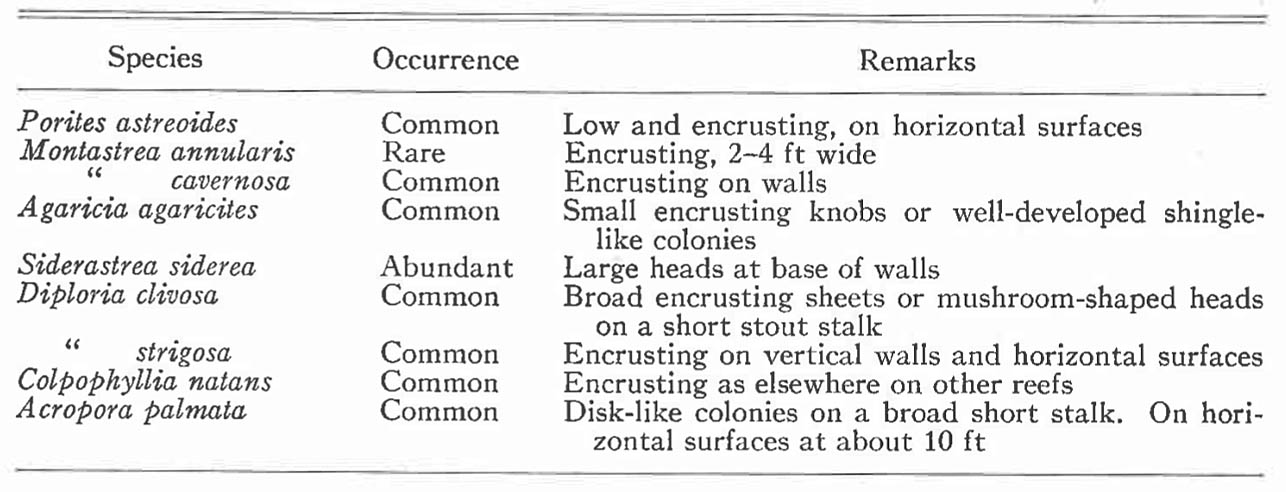
This area of Algal Pavement in Map 1 is very turbulent and hard to visit/examine in detail most of the time. In relation to Lewis’s (1960) description, in 1994 I observed a large colony of Acropora palmata on the algal pavement at about 1.5 m depth at Low Water (see “X” in Map 1 above). The area that lies roughly between 0.5 and 1 meter depth (MLW) in Map 1 is where in 1968/9 I observed many rhodoliths. Closer to shore, over the outer seagrass bed area (of 1969), detached, healthy appearing sea fans were common in 1968, and more recently..
4. PHOTOS
Of Coral Rubble Flats & Beach Rock on East Coast of Barbados
Photos at Bathsheba, Martin’s Bay & Bath (2025) and Frog Rock (2017)
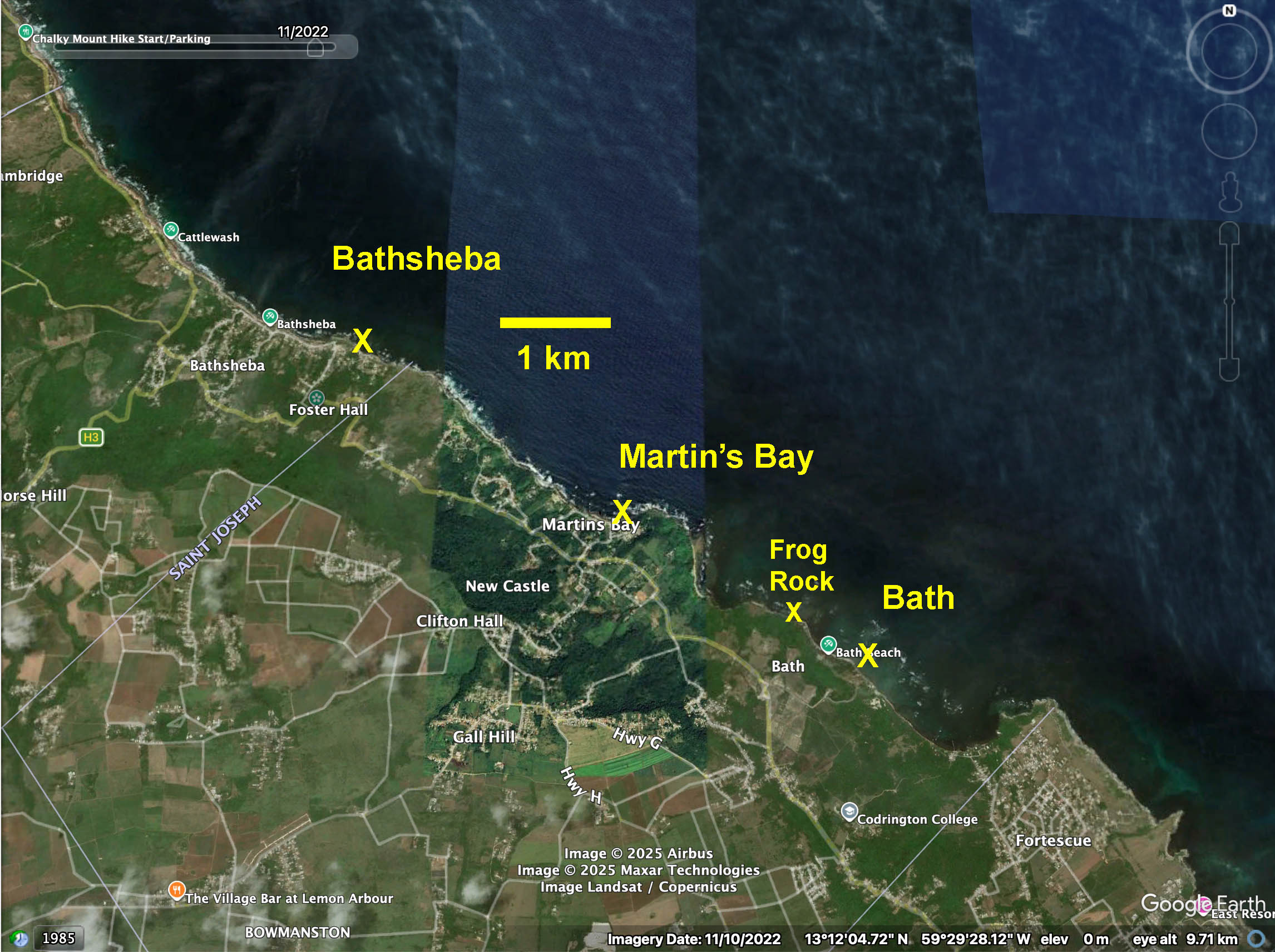
Google Earth Map: Regional Setting for Observations on Coral Rubble Flats on the east (windward) coast of Barbados in 2017 (Frog Rock) and 2025 (3 others)
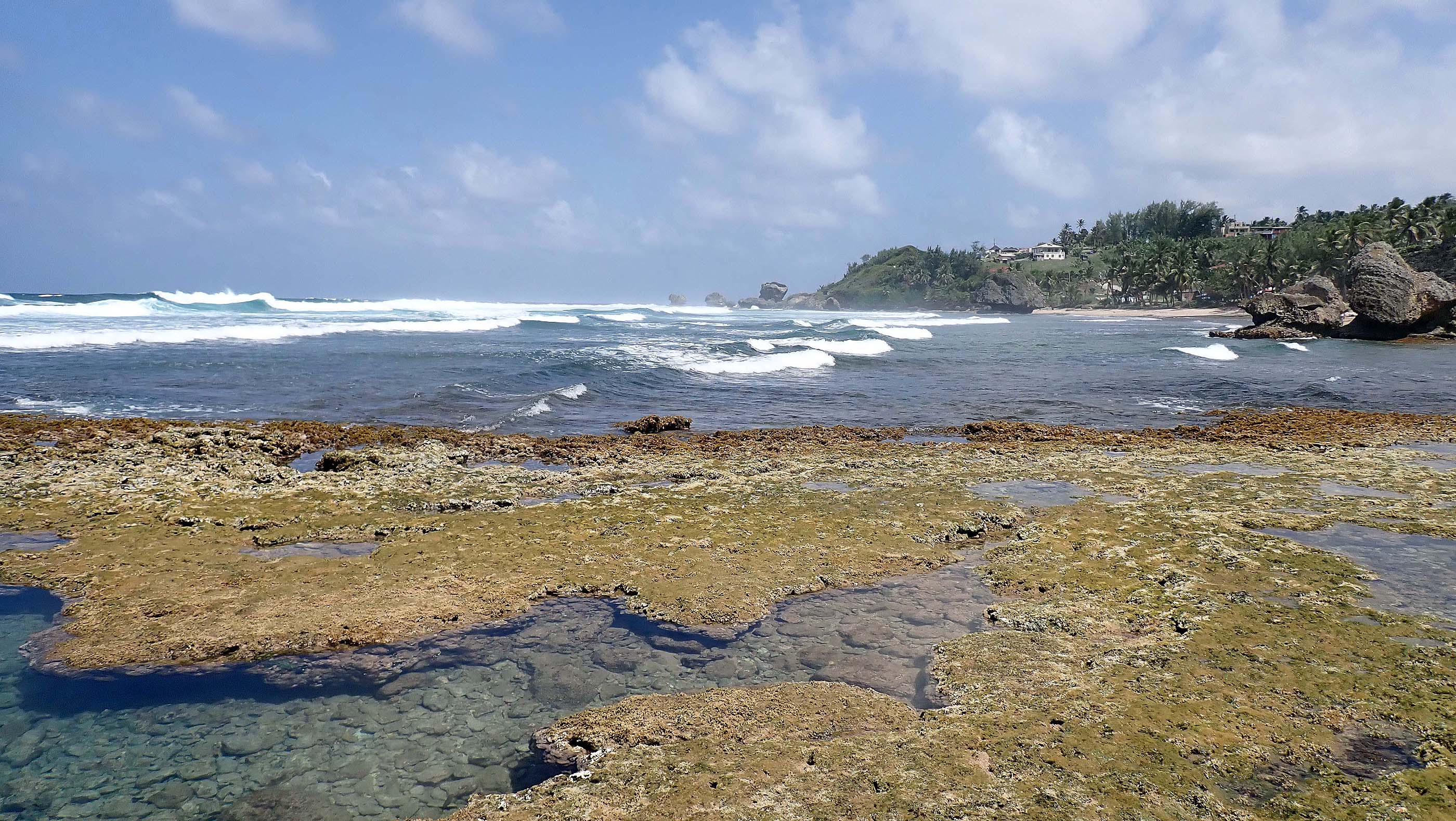 Photo A 2025 #749 Coral Rubble Flats at Bathsheba, Mar 21, 2025. View More Pics |
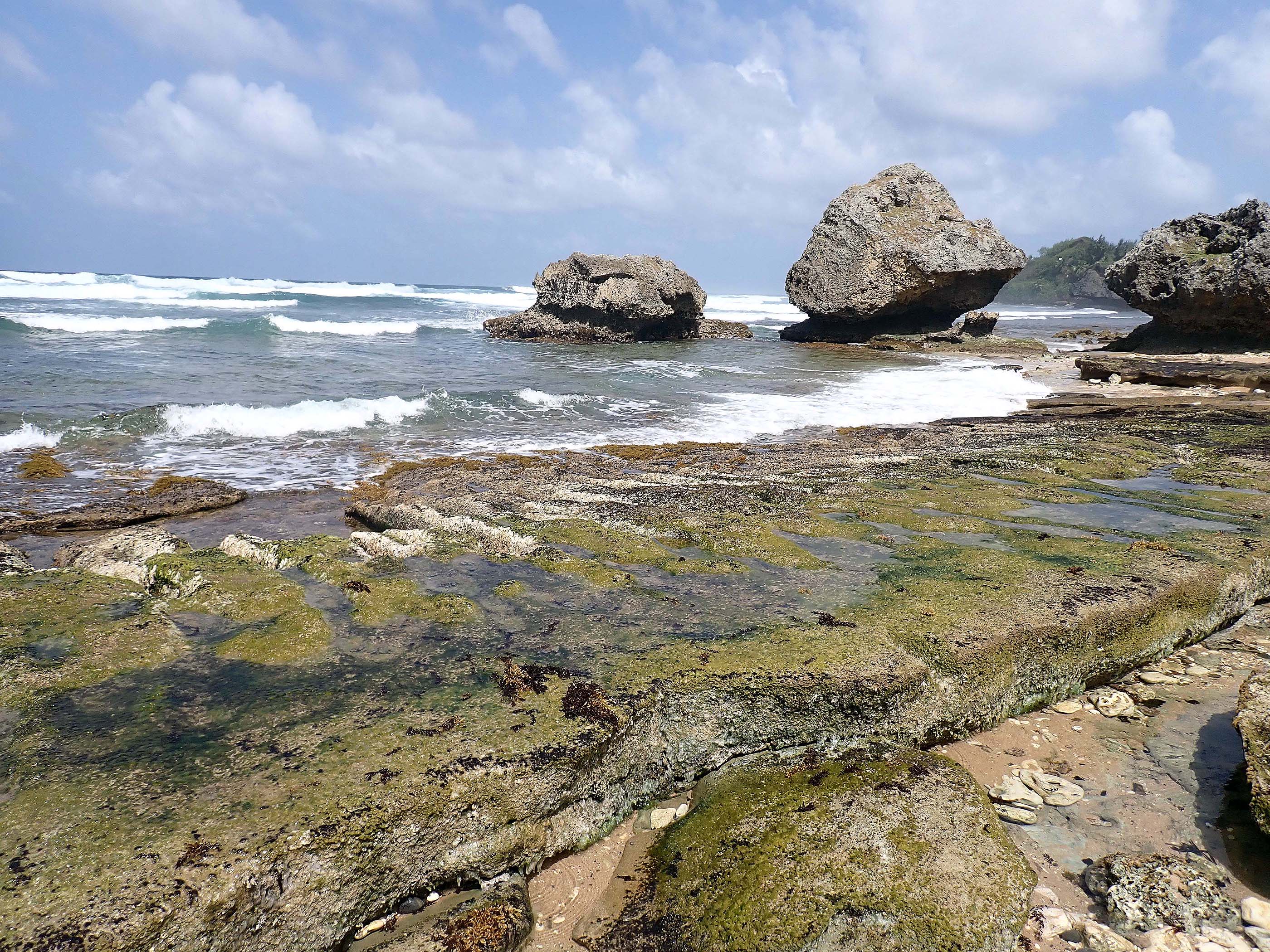 Photo B 2025 #782. Beach Rock at Bathsheba Mar 21, 2025., View More Pics |
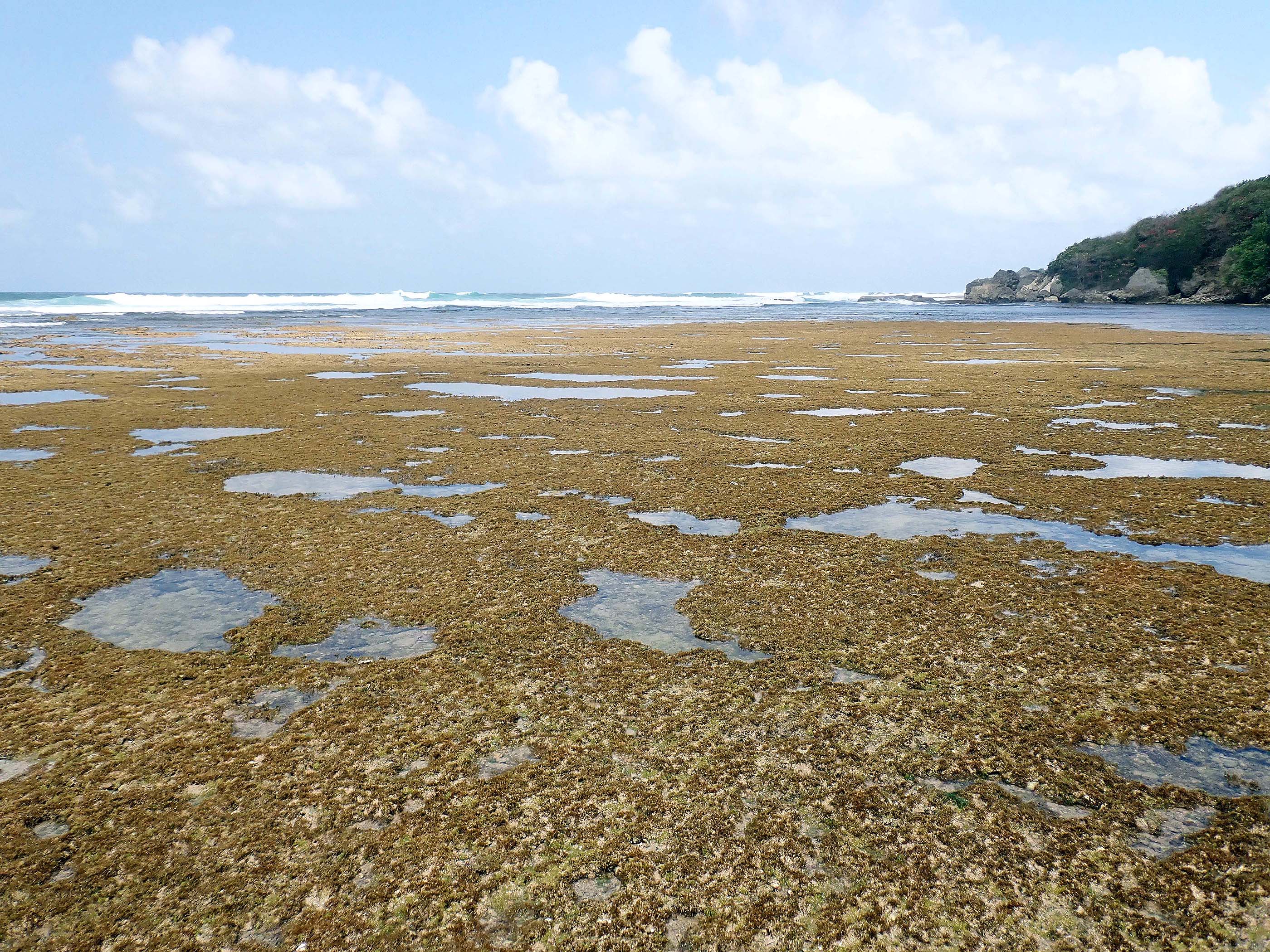 Photo C 2025 #817 Coral Rubble Flats at Martin’s Bay, Mar 21, 2025.. View More Pics |
Photo D 2025 #119 Coral Rubble Flats at Bath, Mar 2, 2025. View More Pics |
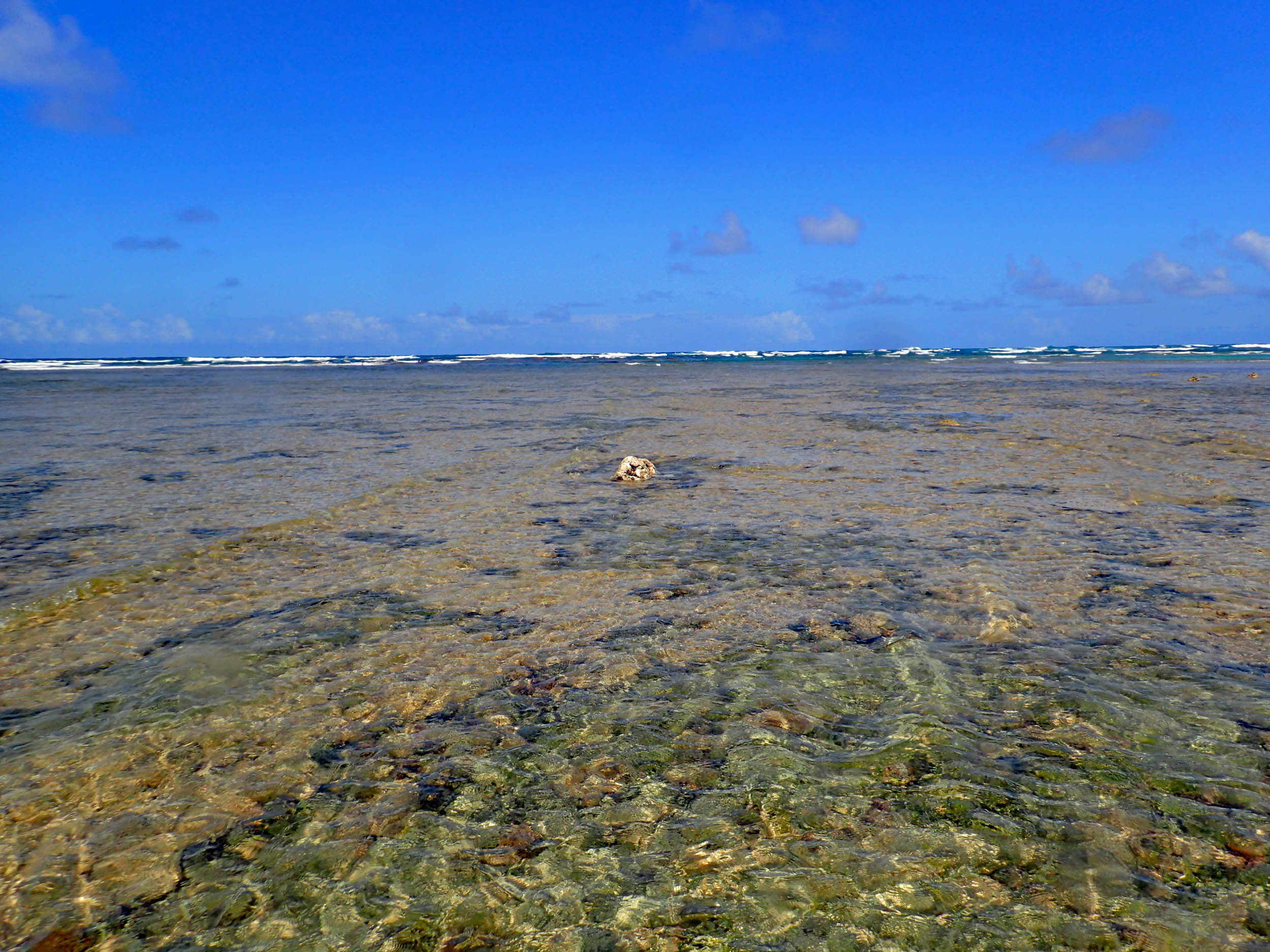
Photo E 2017 #207 Coral Rubble Flats at Frog Rock, Mar 17, 2017. View More Pics
5. NAME EQUIVALENTS TO “CORAL RUBBLE FLATS”
– “Extensive Reef Flats”
Lewis (1960) as. quoted above.
– “Intertidal Reefs – Rock Platforms”
As described in Marine Assets of Yorke Peninsula. Volume 2 of report for Natural Resources – Northern and Yorke, South Australia by J.L. Baker, 2015. “Common forms in the NY NRM region include rock platforms, boulder and cobble fields, and pebble shores. Some of the rock platforms are heavily dissected and contain abundant rock pools, or channels and crevices between the rock slabs. There are many micro-habitats on and in intertidal reefs, such as under ledges / overhangs, in rock pools, in crevices, and underneath rock slabs and cobble.”
– “Intertidal Reef Flats” e.g.,
As described in Extreme Corals: Resilience in the world of intertidal reef flats by Louise Anderson in Reef Bites Apr 16, 2018 “Coral reef ecologists are generally envisaged working on the classically beautiful, tropical reefs of the kind portrayed in Blue Planet II. Less well-known is that there is also ample opportunity to paddle around in the strange, diverse world of intertidal coral reef flats. The Thai island of Phuket is home to several excellent examples of this kind of habitat. These sites completely changed my own perception of coral reefs, and the remarkably hardy corals that live in this environment are particularly exciting to reef scientists because of their ability to thrive under such challenging conditions.”
& As described in Community structure and dietary pathways for invertebrates on intertidal coral reef flats by JP Davis et al., 2015 in Food Webs. Refs removed: “Intertidal reef flats are undervalued habitats relative to their area and distribution on coral reefs, especially given the food sources they provide for both humans and fishes. These habitats are different from other reef zones because reef flat animals are more exposed tophysiological stresses from the extremes of tidal exposure, temperature changes and high turbidity than on subtidal reef flats or reef crests.”
6. ON THE NATURE AND BINDING OF “CORAL RUBBLE”
| – Holocene coral reef rubble and its binding agents (PDF) M.W. Rasser Æ B. Riegl. 2002 In Coral Reefs 21:57–72Abstract [Paragraphing and bolding inserted]A literature review regarding reef rubble (defined as mechanically or chemically abraded parts of frame builders or reef rock larger than sand fraction) and its binding agents is presented.Rubble is produced by natural and man-made events such as storms, wave agitation, earthquakes, bioerosion, ship groundings, and dynamite fisheries. The regeneration of reefs after rubble-forming processes requires rigid rubble binding, which is always preceded by preliminary stabilization.Preliminary stabilization can be achieved by a decline in hydrodynamic energy, interlocking of components, seagrass, and overgrowth by sponges or algae.Rigid binding is primarily achieved by diagenetic cementation. The literature indicates that binding by coralline algae or other organisms (corals, worms, bryozoans) is only of subordinate importance.Highest rates of rigid rubble binding are known from fore-reef areas with low sloping angles above fair-weather wave base; rigid rubble binding is particularly rare in deeper fore-reef environments and not described from the reef crest.Rigid binding by diagenetic cementation is generally known from inter- and supra-tidal near-shore ramparts as well as back-reef, reef-flat, and shallow fore-reef rubble accumulations, while coralline algae rigidly bind rubble only in very shallow fore-reef environments. Rubble binding does not appear to be easily achieved and fewer reports of bound rubble were found than of loose rubble. |
| On Binding – Coral rubble dynamics in the Anthropocene and implications for reef recovery, T.M.Kenyon et al. 2023 in Limnology & Oceanography. References were removed in the extract below. Rubble binding In describing rubble binding processes, we consider rubble that is “stabilized” to be not moving, but not necessarily bound. Loose rubble can be stabilized, for example, by being transported into a sheltered, low-energy environment, such as a depression, or by becoming interlocked with other rubble pieces.Under certain conditions, stabilized rubble can become bound and provide a stable substrate for coral recruitment.Rubble binding can be caused by: (1) biogenic binding by soft organisms that produce flexible binds, or by more rigidly-binding calcifying organisms; and/or (2) cementation, the physically or biologically induced precipitation of calcium carbonate (CaCO3) from seawater to form inter- and intra-skeletal cements.Thus, we use the term “bound” to describe rubble that is connected to other rubble by a binding organism, but binds bridging between rubble pieces may be flexible (e.g., macroalgae, sponges), while the terms “consolidated” and “cemented” are used to describe a subset of bound rubble where (1) the binder is calcifying, producing inflexible binds that remain after binder mortality (e.g., crustose coralline algae—CCA, coral), and (2) where binds are formed through cementation processes, respectively.Binding processes are important precursors to the lithification* of rubble to reef rock, although we have a limited understanding of the succession of binding organisms (including competitive interactions), effective binding rates and strengths, particularly because soft binding organisms are not well preserved in the geological record. *See Encyclopedia Brittania definition of Lithification.” lithification, complex process whereby freshly deposited loose grains of sediment are converted into rock. Lithification may occur at the time a sediment is deposited or later. Cementation is one of the main processes involved, particularly for sandstones and conglomerates. In addition, reactions take place within a sediment between various minerals and between minerals and the fluids trapped in the pores…” Syn-depositional alteration of coral reef framework through bioerosion, encrustation and cementation: Taphonomic signatures of reef accretion and reef depositional events |
7. A NOTE ON “BEACHROCK”
“Beachrock”, found on beaches around Barbados is quite distinct from Coral Rubble Flats.

Page drafted Feb 21, 2026
Page “published” with related post Mar 4, 2026
Update (added Frog Rock) Mar 6, 2026