
NAVIGATION
This page is a sub-page of ObsII, a top-level page on
the website Barbados Fringing Reefs and Seagrass Beds
(www.versicolor.ca/barbados).
Go to Obs II for a list of other subpages in this section
of the website.
I have observed the Vauxhall Fringing Reef in the early months of 2015 to 2020, 2023, 2024 and 2025. In these “snapshot views”, the reef was seen, and recorded in photos and videos, as very healthy until early 2023 when I observed the initial spread SCTLD on the reef. In 2024, I viewed the effects of extreme warming events in fall of 2023, those mostly on Acroporoid and Stinging corals. In 2025 I viewed the massive physical disruption of the outer spurs which had been 80-95% covered with living corals, this attributable to swells associated Hurricane Beryl of June 30/July 1, 2024.

Reefs of the Barbados MPA. “Vauxhall Reef” (as referenced on this website) is reef #34. Click on images for larger versions.
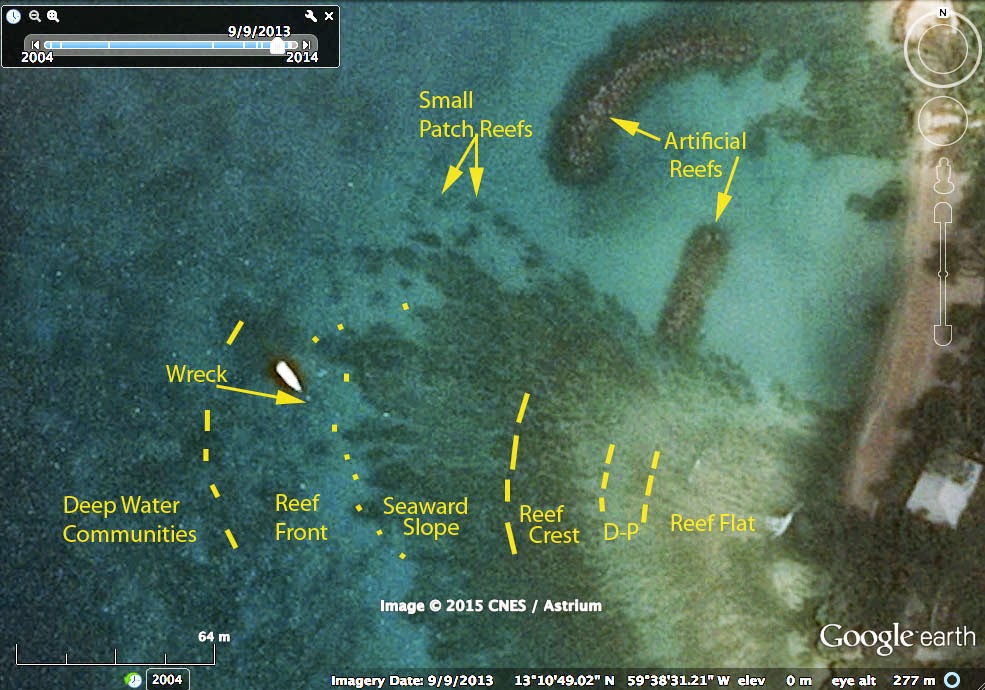
Zones on the Vauxhall Reef, after Lewis (1960)
Click on mages for larger versions
My annual visits to the reefs of the Folkestone MPA 2015 to 2025 (excluding 2021 an 2022 when I did not visit) occurred over 1 to 3 month periods within the months January to April, thus any observations I make on the state of the reefs are essentially snapshots taken in the winter months. My focus has been on Vauxhall Reef (Reef # 34 in Maclean & Oxenford, 2016), but I have also snorkelled throughout the area of fringing reefs in the MPA.*
*Vauxhall Reef, as observed 2015 to early 2023, had much higher cover and diversity of living corals than from other fringing reefs in the MPA which are highly degraded. See What differentiates Vauxhall Reef?
I have summarized my observations and conclusions concerning Vauxhall Reef and other reefs in the MPA in the early months of 2015 to 2024 (2021 and 2022 excluded) in annotated slides from a presentation at the CORALL AGM in 2024.
Highlights of my observations in those years are given below, followed by “Snapshot 2025 ” which consists of reports & comments on my observations in early 2025. The basics are posted now (Dec 15, 2025); I will be adding more details over the next couple of months or so. – david p
My reference to zones on the fringing reefs follows the delineations of Lewis (1960); see Zones on this website for how the Lewis zones relate to the more generally applied CERMES zones.
Vauxhall Reef: Its Remarkably Healthy State 2015 to 2020
Over the 6 years 2015 to 2020, I marvelled at
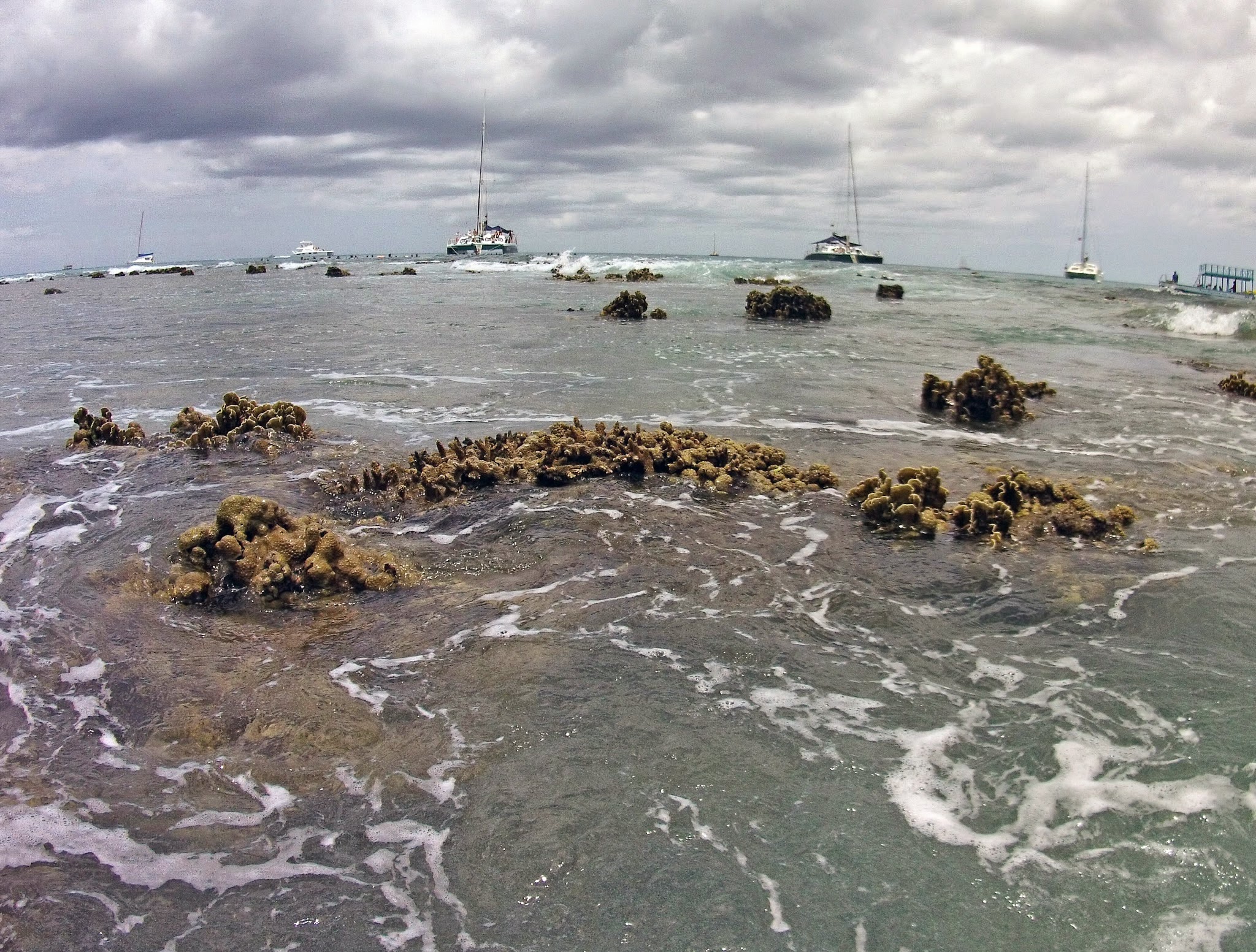
Colony of Acropora prolifera at the inner Reef Crest zone of Vauxhall Reef exposed on a very low tide on April 21, 2015. Snorkelling Boats in the background are anchored near ‘The Wreck”
– the overall healthy state of the Vauxhall Reef from the Reef Flat to the Deep Water Communities;
– the high living coral cover and fish diversity on the Seaward Slope;
– the vigorous growth of the hybrid acroporoid, Acropora prolifera at the inner Reef Crest. A palmata occurred as isolated colonies over a broad N-S strip within the Seaward Slope and A. cervicornis in patches in a fairly restricted area within the Reef Front.
I noted the significant economic benefits accruing from the visits of snorkelling boats to The Wreck and the adjacent outer fringing reef.
I did not visit in 2021 and 2022.
2023: The “Years of the Vicissitudes” begin with SCTLD (Observations in 2023 Jan 8 to Apr 8)
2023 turned out to be the first “Year of the Vicissitudes”, when the all-good-news story about Vauxhall Reef would change due to causes originating well beyond the shores of Barbados.
When I first arrived in January of 2023, I immediately looked for occurrence of SCTLD (Stony Tissue Loss Disease) which I had been on the lookout for* but did not find in 2020.
*re Post: Stony coral tissue loss disease heading towards Antilles 9Jul2019

Corals on landward corner of The Wreck on Jan 11, 2023
“On January 11, 2023, conditions were perfect for snorkelling at the Vauxhall Reef* and I looked out for SCTLD-infected corals on a route approx. perpendicular from shore that took me across the Reef Flat, Diploria-Palythoa, Reef Crest, Seaward Slope and Reef Front zones (Lewis 1960), to ‘The Wreck”. I saw only one obviously infected coral, that in the outer Reef Crest zone, until I reached The Wreck where there were many, and at least some of them appeared to fit the description for Stony Coral Tissue Loss Disease.” (See Presumptive SCTLD on Vauxhall Reef & Environs in 2023)
It appears that the earliest reports of presumptive SCTLD in Barbados were in late Nov 2022. I watched and documented rapid development of presumptive SCTLD corals over the period Jan-Apr 2023 submitting 26 reports to AGGRA. AGGRA declared Barbados to be confirmed for SCTLD on May 8, 2023.
***To add some details re: coral species infected.
I was relieved that the Acroporpoid corals at Vauxhall (A. palmata, A cervicornis and A prolifera) and elsewhere in Barbados (near exclusively A. palmata – see Maclean & Oxenford, 2016) were untouched by SCTLD, as reported for acroporoids over the tropical Atlantic at large.

Bleaching Alert Area and Outlook 2023-09-09
From CARIBBEAN CORAL REEF WATCH, SEPTEMBER – DECEMBER 2023
2024: Effects of Extreme Warming/coral bleaching events in the fall of 2023 were all too evident (Observations Jan 14 to Apr 8)
Extreme warming/coral bleaching events occurred in the fall of 2023. I looked for their impacts at Vauxhall immediately on my arrival in early 2024. Extreme warming has been reported to be especially hard on acroporoid and stinging corals, corals that are not impacted by SCTLD. Unfortunately, the impacts of the extreme warming events were all too evident. All specimens of the hybrid coral, Acropora prolifera, at Vauxhall Reef ware dead and darkened by overgrowth with epiphytes. A. palmata fared much better, and there were a few vestiges of living coral on A. cervicornis specimens. The very common stinging coral Millepora complanata was heavily impacted – probably >90% mortality but the less common branched stinging coral M. alcicornis was largely untouched.
The ravages of SCTLD continued in 2024. To add some details.
2025: Hurricane Beryl (June 30/July 1, 2024) had massively disrupted the once high living coral cover of Vauxhall Reef spurs (Observations Feb 4 to Apr 2, 2025)
“Between the night of 30th June and the first 12 hours of 01st July [2024], Barbadians watched and felt the passage of Hurricane Beryl as it tracked towards Barbados from an area to the southeast of the island. As was noted at the time, Beryl was the first hurricane to form in the Atlantic this early in the hurricane season…. In speaking to fisherfolk and those who make their living from the sea or along the coast, never in living memory has anyone seen sea swells like those which pounded the south coast and decimated much of the west coast. Even infrastructure designed decades ago to withstand severe weather systems proved little match for the destructive swells of Hurricane Beryl.” – Statement on the passage of Hurricane Beryl by Minister of Home Affairs and Information, Wilfred Abrahams.
Surely one of the most distinctive features of the Vauxhall Fringing Reef that I observed 2015 to 2024 was the high living coral cover on the spurs that extend out in the Seaward Slope zone onto the sands of the Reef Front; with the associated abundance and diversity of fish they afforded spectacular snorkelling to the many visitors arriving via west coast day cruises and mooring to fixtures in the area of “The Wreck”.
Onset of SCTLD in 2023 and high mortality of stinging corals associated with extreme warming events in 2023 initiated large losses in living coral cover on spurs but did not affect the finger and pencil corals. There followed in 2024 extreme wave disturbance associated with Hurricane Beryl (June 30/July 1, 2024); it was, by far, a much larger & more disruptive disturbance of the spurs than were SCTLD and coral bleaching because of its impact on the finger and pencil corals (Porites and Madracis spp) We can hope that it will not be repeated for some time, thereby allowing some significant re-building, at least by coral species not severely impacted by ongoing SCTLD and extreme warming events.
PHOTOS & VIDEOS OF SPURS BEFORE AND AFTER HURRICANE BERYL
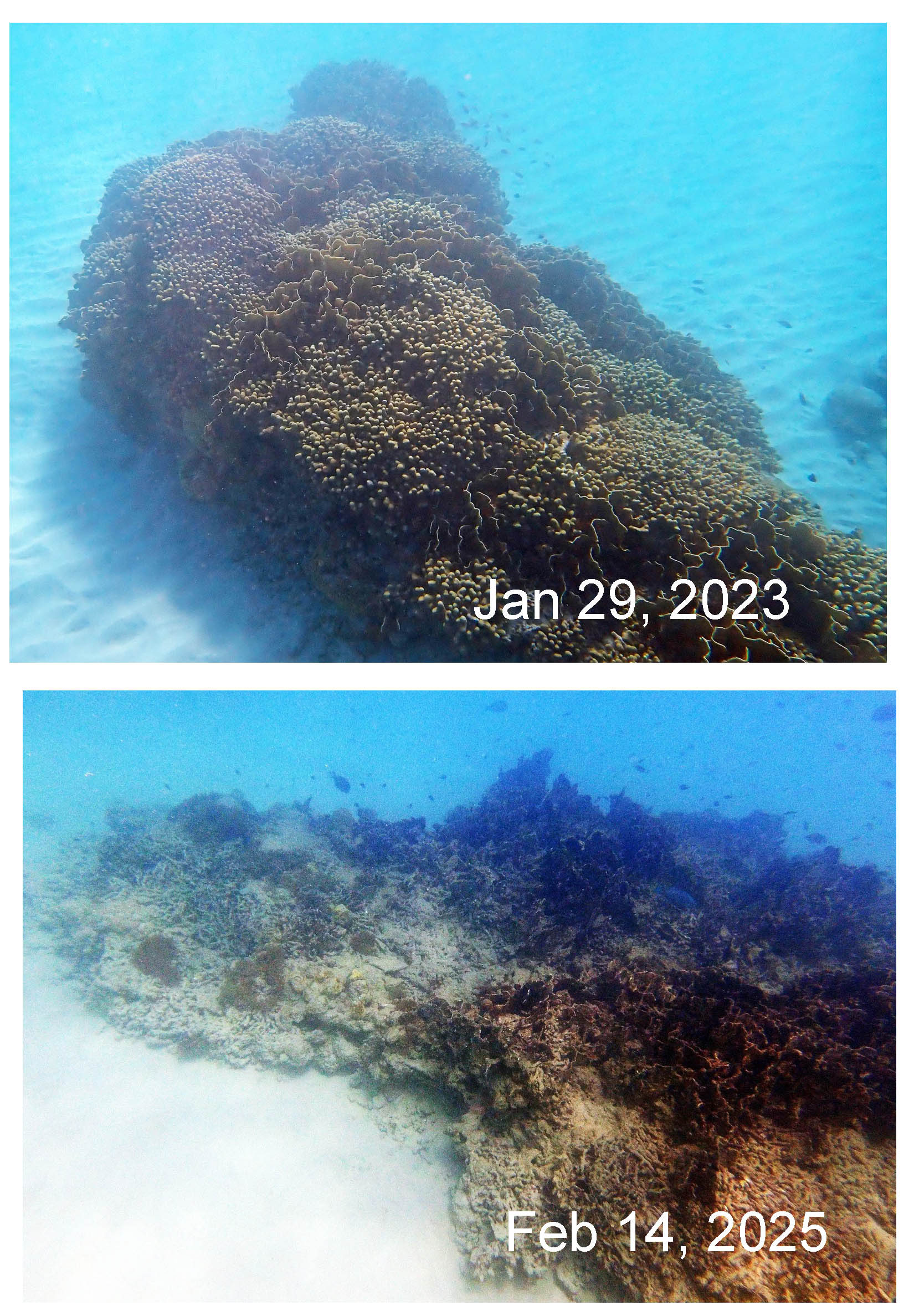
Right Top: Tip of spur Vauxhall Reef, vicinity of The Wreck, early 2023 >85% living coral. Stinging Coral (Millepora complanata, the platy corals in pic) would be completely killed by extreme warming in 2023 and 2024. The Porites (finger) and Madracis (pencil) corals are later physically broken and scattered by Hurricane Beryl (July 1, 2024).
Right Bottom: Tip of spur (likely same spur; same area) in early 2025. Finger and pencil corals totally disrupted. Living coral cover <10%.
View related videos:
 Video of Healthy Spurs |
 Video of spur disrupted by Hurricane Beryl |
Other conditions/phenomena/trends of possible note observed in 2025 (Feb-Apr) compared to earlier years
These observations are in note form and are largely “imressions”/anecdotal at this time; (Nov/Dec 2025); I need to to elaborate, to confirm (or not) these observations through more detailed examination of my many photos and videos.

Bleaching Alert Area and Outlook 2024-09-07
From CARIBBEAN CORAL REEF WATCH, SEPTEMBER – DECEMBER 2024
Related to Extreme Warming
– Stinging Corals In 2025, there continued to be very little recovery or survival of Millepora complanata following the extensive die-off and overgrowth by epiphytes (algae, fungi) that I had observed in 2024 and attributed to extreme heating events in 2023, such events perhaps ongoing. The dead colonies appeared darker and to support lower levels and diversity of associated life. There were occasional living colonies, some young in appearance. There were fewer living M. alcicornis than I had noted in 2024.
– Acroporoids There were absolutely no signs of any new growth on the hybrid coral Acropora prolifera at Vauxhall Reef which in 2024 was observed to have been 100% killed off, apparently by extreme warming events in fall of 2023.
– Likewise, there appeared to be little recovery of A. cervicornis, however visibility was continuously poor and I could not get a good look at the colonies on the Reef Front of Vauxhall Reef (they lay close to the limit of my snorkelling depth in 2025).
– I observed only dead A. palmata on Vauxhall Reef in 2025, but as noted below A. palmata on the Surfside Breakwater 2 remained healthy.
–
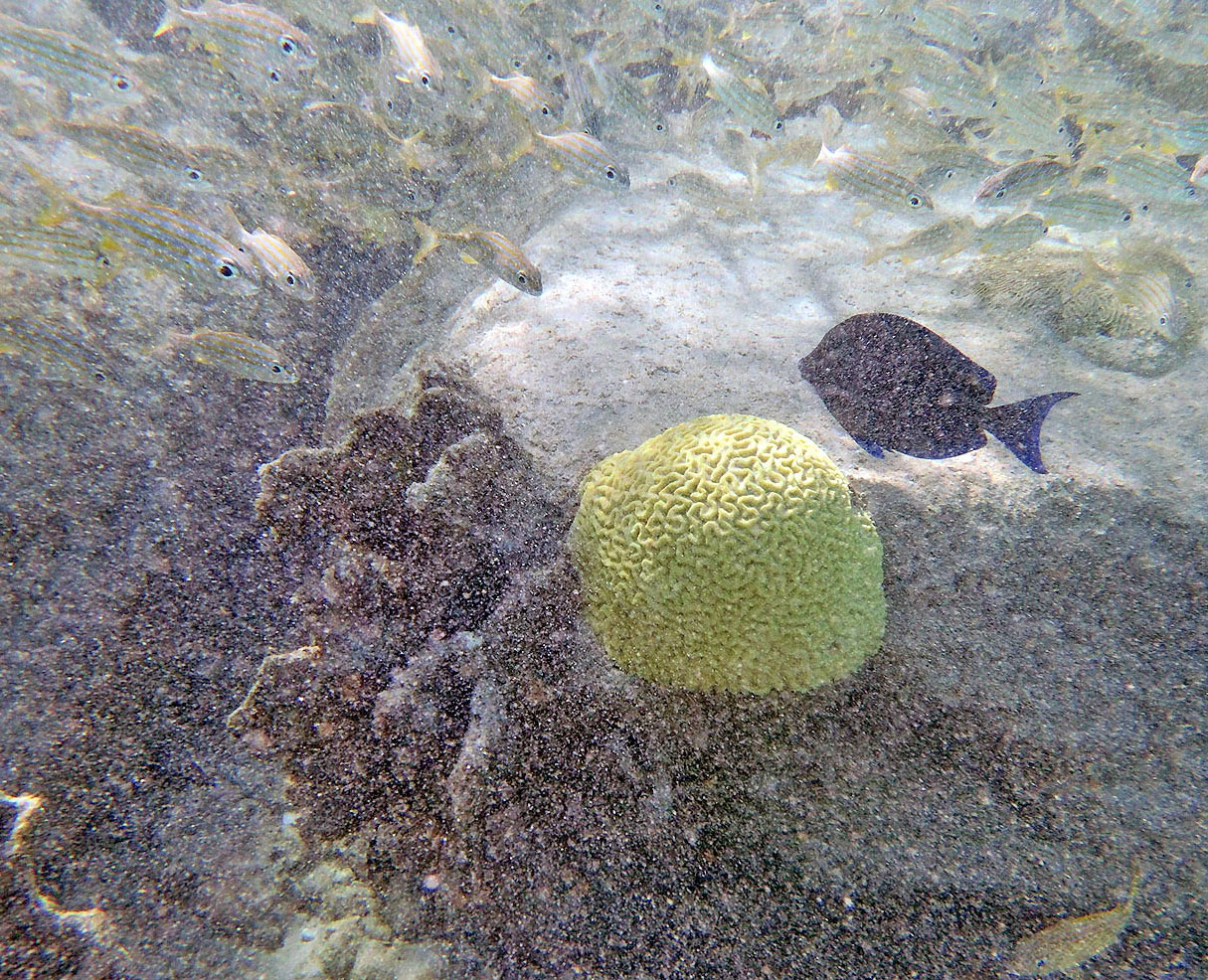
Pale yellow P. strigosa on breakwater, Feb 5, 2025.
Brain Corals I noted on breakwaters and on fringing reefs proper many brain coral specimens that were pale green. I assume that these corals are in the process of losing their zooxanthellae and in some cases could recover.*.
*e.g., see Monitoring coral bleaching using a colour reference card, U.E. Siebec et al., 2006 in Coral Reefs
SCTLD
– Compared to 2024, there appeared to be more healthy brain coral specimens free of SCTLD on breakwaters and on the seaward slope of Vauxhall Reef.*
– Compared to 2024, spread of SCTLD on Orbicella annualaris colonies appeared to have stopped/not increased.*
– In 2025, all pillar coral colonies, save one, were 100% or close to 100% dead/infected by SCTLD. One smaller colony in the Seaward Slope zone towards the southern extremity of Vauxhall Reef was entirely healthy.
*Yet to be confirmed (or not) by reference to 2024 and 2025 photos.
Fish
Parrot fish, several species and a range of sizes, were still common and abundant on Vauxhall Reef in 2025. Notably absent were Scrawled Filefish which had been commonly seen in earlier years; ‘not sure about status other species of file fish, I think overall they were less abundant than in earlier years. Overall, there was much less fish activity around and within the “squarrose” stinging coral colonies which had died off when observed in 2024 but in 2024 were still hosting or were feeding grounds for large and diverse fish populations. TO ADD LINKS
In 2025, I noted, as I had in 2024, common occurrence of schools of “garfish”/needlefish tentatively identified as houndfish near the reef crest at Vauxhall, and particularly near the reef crest on the next fringing reef to the north (MPA Reef no 33). I have records of these fish in 2023, but not earlier; I do not recall seeing these fish 2015 to 2020. However when I did see them 2023 – to 2025, they were at locations close to the limit my vision, so it’s possible that in earlier years I just hadn’t been sensitized to their presence sufficiently to be on the lookout for them. View “Gar” and “Garfish” in Barbados 4Oct2025
Water Clarity
I did not encounter a day in 2025 (Feb 4 to Apr 1) when waters from the outer Reef Flat zone to the Deep Water Communities at Vauxhall and elsewhere in the MPA were “crystal clear”. Rather it seemed that, unlike in previous years – when often the near shore (on the Reef Flat, and open sandy areas nearer to shore) waters were cloudy, but waters from approx the Reef Crest and beyond were much clearer – in 2025, the reverse was often true: the outer waters were constantly “cloudy” even “milky”. I was very aware of the water clarity as I was always looking out for days when the outer waters would be crystal clear so I could obtain better photos and videos of the deeper areas of reef; such a day never materialized. ‘Need to look for reports on visibility in other areas of the Caribbean… I am wondering (out loud): are the massive influxes of Sargassum creating some type of eutrophication (even though they rarely come in en masse to the Holetown area)? Or are the overall seemingly more turbulent waters stirring things up more, releasing more nutrients perhaps??
The “Surfside Breakwater Anomaly”
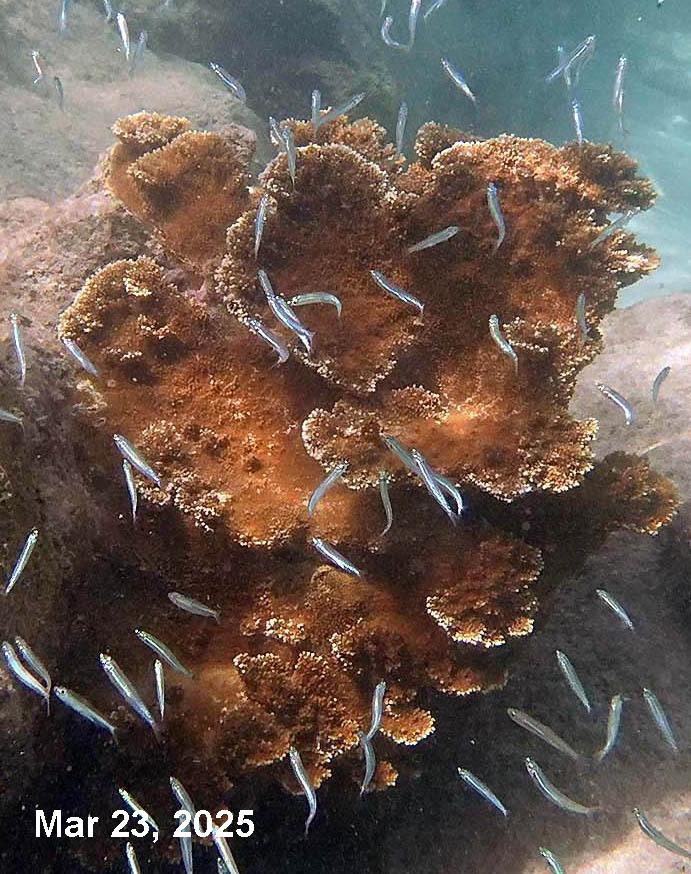
Eight Acropora palmata specimens on “Breakwater 2:” in the SurfSide area show little evidence of bleaching, even though there are many pale or bleached P strigosa, and heat killed Millepora complanata on that breakwater.
View A. palmata in nearshore MPA north of Vauxhall: SurfSide Breakwaters.
Loss of Seagrass
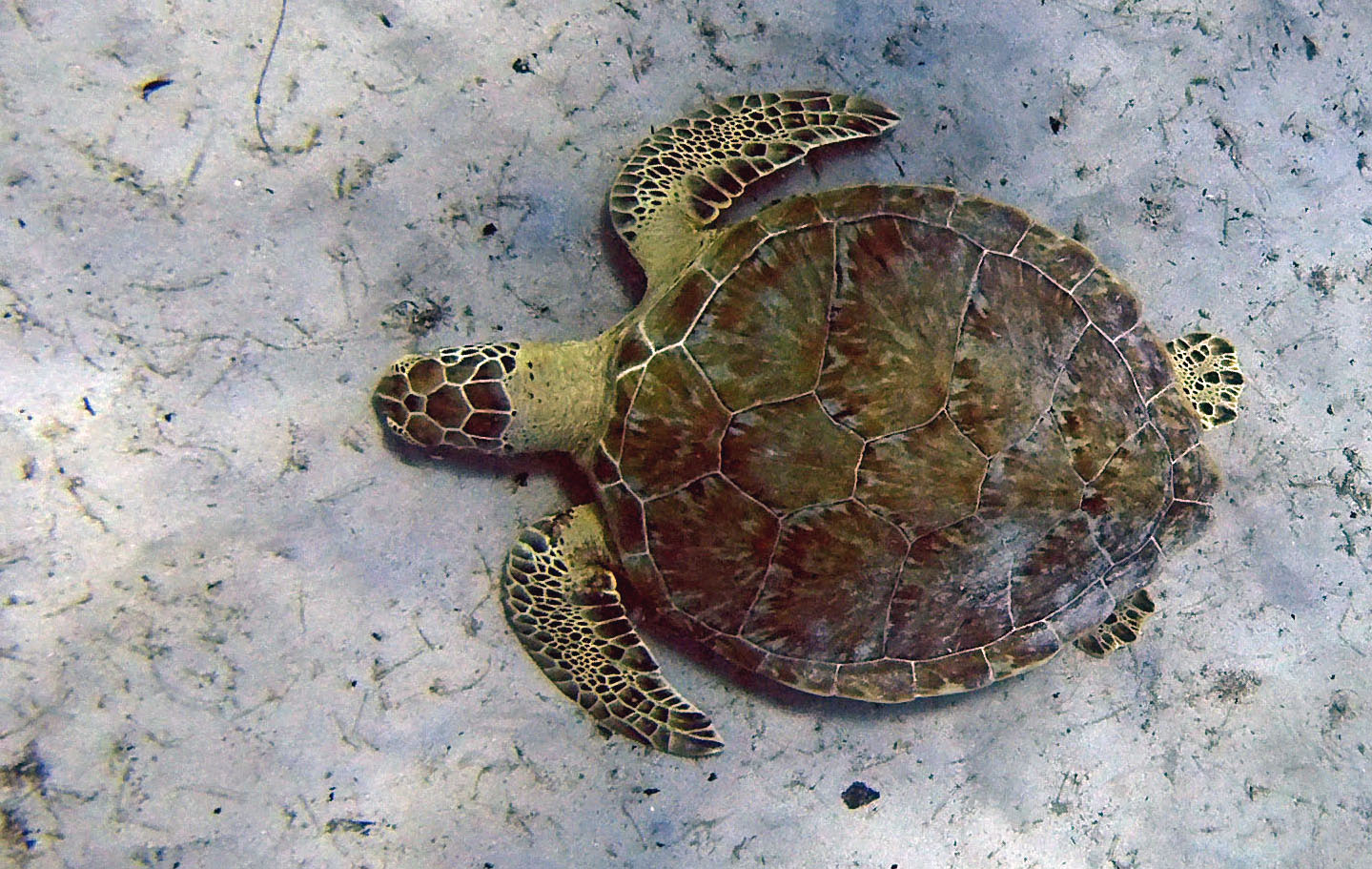
Green Turtle in over sparse seagrass (Halodule wrightii), circa 20 feet depth, SurfSide area Jan 28, 2023
It seems there was little of no seagrass (Halodule wrightii) left in the waters off of Surfside in 2025 – I assume a result of wave disturbance by Hurricane Beryl in 2024. It was sparse in earlier years, perhaps because of turtle grazing. The once rich seagrass beds at Bath on the east coast are no more (visited every year when I was in Barbados 2015 to 2025).
Spread of exotic green alga
To date, photos of a green alga from Barbados uploaded to iNaturalist that appear to be Boergesenia forbesii have commonly been identified as Valonia utricularis (some gaining Research Grade status), or a species of Ulva or Caulerpa. A suggestion that a specimen I had identified as Valonia sp. was in fact a species of Boergesenia prompted me to investigate further.
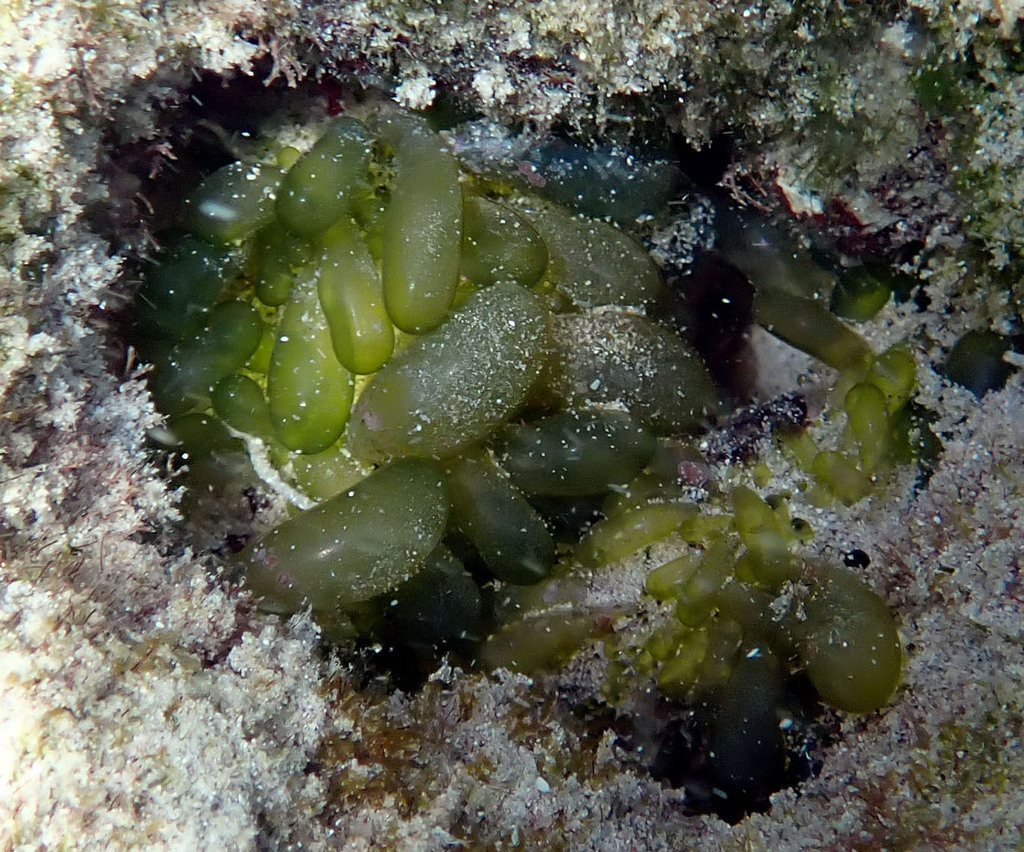
Boergesenia forbesii filling a cavity in old coral bedrock in Reef Flat Zone at Vauxhall Reef. It’s the only occurrence I have viewed to date (Apr 2, 2025) at Vauxhall Reef
The Conclusion: I agree with the ID of Boergesenia forbesii for many of the specimens I had thought to be Valonia utricularis. Overall, reports in the literature and on iNaturalist records suggest that the earliest occurrence of Boergesenia forbesii in the Caribbean was in Puerto Rico (2008 reported collection date), and that it has spread southward reaching Barbados sometime between 2008 and 2016.
Of Indo-Pacific origin, Boergesenia forbesii is clearly a recent immigrant to Barbados. I have seen only one specimen of it in the MPA, but it is abundant on the nearshore reef flats on the south and east coast. More about it here. While exotic in origin, I don’t think it is invasive in the sense of disrupting an existing ecosystem… but that’s a hypothesis at best!
Postscript
 While I was putting together this “snapshot”, the GCRMN issued “Status and Trends of Caribbean Coral Reefs: 1970-2024”. It describes broadly similar changes to those I have noted above – but in much more detail – throughout the Caribbean region, including Barbados.
They do conclude however, that there is “Hope & Opportunity”
Despite the scale of decline, the report highlights evidence of recovery where local pressures are effectively managed. Protected or well-managed reefs show higher coral cover, greater biodiversity and stronger resilience to heat stress.
GCRMN lists “five priority recommendations for governments, partners and the private sector to strengthen reef resilience and protect coastal livelihoods.”
Some components of those recommendations are already in place in Barbados. I firmly believe that the Barbados people have the competence, the imagination and the will* to implement all of them and more, indeed to contribute significantly to and provide leadership in, global efforts to “Save our Reefs”.
*E.g., as expressed in the recently released Implementing Mission Barbados: A roadmap for state transformation