
ObsSG: Observations on Seagrasses
 Navigation
Barbados Fringing Reefs & Seagrass Beds
Natural History Perspectives of a Visiter
– ObsSG (This Page, a top-level page)
Other top-level SG Observation Pages:
– ObsSG-Bath (Seagrass at Bath)
– ObsSG-SL (Seagrass at St.Lawrence)
Also view on this website:
– About:Seagrass Beds in Barbados
– Lit & Links/BB Seagrass
| SUBPAGES OF ObsSG (This Page) – Seagrass in Barbados – Substrate Types – Coral Rubble Flats, Algal & Gorgonian Pavements – – Bathsheba – – Martin’s Bay – – Bath – 1999 Ref List |
– Carriacou Seagrass Beds |
ON THIS PAGE
|
ON THE STATE OF SEAGRASS BEDS IN BARBADOS IN 2002 From A National Biodiversity Strategy & Action Plan for Barbados (2002) : “Seagrass areas, commonly known as seagrass beds or meadows, are distributed along the coast in shallow water where sunlight penetration is adequate to facilitate photosynthesis. Delcan (1994b), reported seagrass beds along the west coast at Shermans, Six Men’s Bay, Speightstown and Brighton; along the southwest coast at Bridgetown, Hastings, Rockley, Worthing, St.Lawrence, Dover, Maxwell, Welches, Oistins, Enterprise and Atlantic Shores of Barbados; and along the east coast at Bath and Conset Bay. “There is evidence that the quality of the local coastal marine water is deteriorating due to increased sedimentation, eutrophication and sewage pathogens, localised increases in temperature, decreases in salinity, and perhaps increases in toxins (Delcan, 1994a). There is also evidence to suggest that grazing by fish and sea urchins is an important mechanism for recycling nutrients within the beds. Heavy fishing pressure that results in the removal of these animals can therefore also negatively affect the vibrancy seagrass beds. Physical damage in coupled with poor water quality will negatively impact on the vibrancy of seagrass beds. It is therefore probable that the local seagrasses are being impacted negatively by many coastal activities and land based sources of pollution and urgent attention must be given to ways of minimizing these impacts” |
—–
Most of what I have to offer on these pages are not recent observations of seagrasses at Barbados, but historical observations over the period 1969 to 2015. (In contrast the Observations on Fringing Reefs reported on this website are mostly from 2015 onward.)
The lack of more recent observations is in part because post-2025, there is very little left of seagrass beds in Barbados, as a “guesstimate”, perhaps 1/20th of the area of seagrass in 1969. Some of the factors lading to that decline are cited above.
The origin and context of my “historical” observations are explained below.
CONTEXT OF SEAGRASS OBSERVATIONS AT BARBADOS & CARRIACOU 1969 to 2025
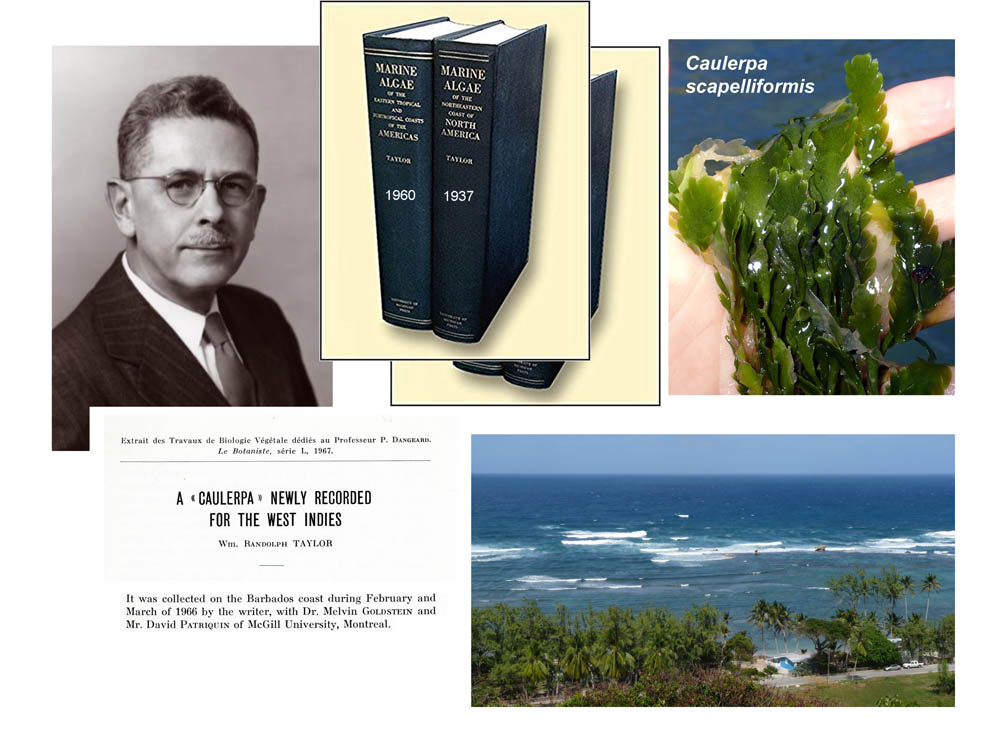
William Randolph Tylor. View Caulerpa paper
I first visited Barbados over a 3-week period in February of 1966. I had been invited by my McGill University Phycology (algae) class Prof, Mel Goldstein, to assist him and William Randolph Taylor in collecting seaweed specimens in Barbados. We were based at the Bellairs Research Institute (McGill University) located in Holetown, Barbados.
That venture led to my attending a 6 week summer course in Tropical Marine Biology at the Bellairs Research Institute (BRI) in the summer of 1966. As it was drawing to a close, the Director (and founder) of BRI, Prof John Lewis (McGill University) asked if I would be interested in doing PhD research at Bellairs “on seagrasses”.
At the time, there was very little known about tropical seagrasses and he would allow me to choose the particular direction of the research. I had just completed a MSc at McGill on Arctic cod, and had spent the summers of 1961-1965 as a research assistant on an experimental 37 ft fishing boat in the western Arctic… I loved it, but a lot of the time was spent stuck in ice packs. So I was looking around for a more predictable alternative field-wise for my PhD research and my interests were shifting from marine fish to marine plants, so… I accepted Prof. Lewis’s offer and began my research in July of 1967.
My focus was on nutrient cycling and answering the question, “How is turtle grass (Thalassia testudinum) so productive in nutrient poor topical waters?” In reading all I could about seagrasses over the intervening year, I was intrigued by the suggestion of the marine microbiologist EJF Wood (1965) that “[the seagrass] Zostera seems to be confined to areas where sulphide is present possibly because of the release of phosphate brought about by sulphate reduction”.*
* EJF Wood, 1965. Marine microbial ecology, 243 pages, London: Chapman & Hall, pp108-109

My spouse assists/directs me “in the lab”, 1968
So I set out to test that hypothesis on T. testudinum in Barbados. Could the high productivity be explained by release of phosphorus in the sediments stimulated by seagrass-induced reducing (anoxic, anaerobic) conditions?
I had 3 years in total to complete my field research. After about 15 months, progress was proving to be slow and I decided to switch to a more predictable path of research. I would do formal (quantitative) surveys of seagrass beds and associated benthic flora and fauna around Barbados, and around the island of Carriacou (Grenada); I included the latter because seagrass beds there were much more extensive than in Barbados and more typical of the Caribbean broadly, especially the meadows that occur in the lagoons behind barrier reefs of the east coast of the island.
I completed that field work within a year, but in the process figured out a new tack on the nutrient issue*, so I again pursued that avenue, completing the nutrient research by the beginning of 1970. I wrote my thesis on “The origin of nitrogen and phosphorus for growth of the marine angiosperm Thalassia testudinum” I published 3 papers on observations I made as components of the survey**, but except for some qualitative description of seagrass beds in my thesis, and in the “blowout paper”, the surveys themselves were not published.
*On the new tack. In the course of the surveys I observed big diffs. in the length (height) of T. testudinum blades between diff. sites. I wondered if the length was a function of the growth rate; J. Zieman had published a new, simple method of measuring leaf growth, I used it and indeed found a high correlation between length and growth rate. So then I could use leaf length as a measure of growth rate and look for relationships between growth or production/yield and various measures of nutrients in the sediments… To my surprise I found relationships between yield and sediment nitrogen but not with sediment phosphorus…See The origin of nitrogen and phosphorus for growth of the marine angiosperm Thalassia testudinum, Patriquin, D.G. 1972. Marine Biology 15: 35-46, and Nitrogen fixation in the rhizosphere of marine angiosperms Patriquin, D.G. and R. Knowles. 1972. Marine Biology 16: 49-58.
** The 3 papers:
– Estimation of growth rate, production and age of the marine angiosperm Thalassia testudinum König,David G Patriquin, 1973. Caribb J Sci 13: 111−123 Available on Dalspace;
– Carbonate mud production by epibionts on Thalassia: an estimate based on leaf growth rate data. Patriquin, D.G. 1972. Journal of Sedimentary Petrology 42: 687-689;
– “Migration” of blowouts in seagrass beds at Barbados and Carriacou, West Indies, and its ecological and geological implications, DG Patriquin, 1975 Aquatic Botany Volume 1, Pages 163-189. View PDF
In 1993, Dr. Wayne Hunte , then Director of BRI and a prof. at UWI Cave Hill, knew about the survey work and asked me to repeat the surveys. I did so in 1994.*
*My Dalhousie University colleague Robert Scheibling collaborated in the repeat observations of 1994. The 1994 field work was supported by funds from several sources courtesy of Dr. Gary Newkirk at Dalhousie University and Dr. Wayne Hunte at Bellairs/UWI.
Some of the 1969 and 1994 data on T. testudinum growth and productivity were made use of by Lotus Vermeer in her PhD thesis*, but otherwise the survey data of 1969 and 1994 were (again) not published.
*Lotus Vermeer initiated her PhD research on seagrasses in conjunction with the 1994 surveys. See Changes in seagrass growth and abundance of seagrasses in Barbados, West Indies, PhD thesis, Dalhousie University, July 2000; and Effects of shoot age on leaf growth in the seagrass Thalassia testudinum in Barbados , LA Vermeer & Wayne Hunte, 2008. Aquatic Biology 2(2):153-160.
I had analyzed and written the surveys up by 1999, but the stresses of the day prevented me from finally getting it all published. Ten years went by after completion of the field work and I mused, “Now it’s just too late, I will do the surveys again when I retire so it’s all timely and pertinent”.
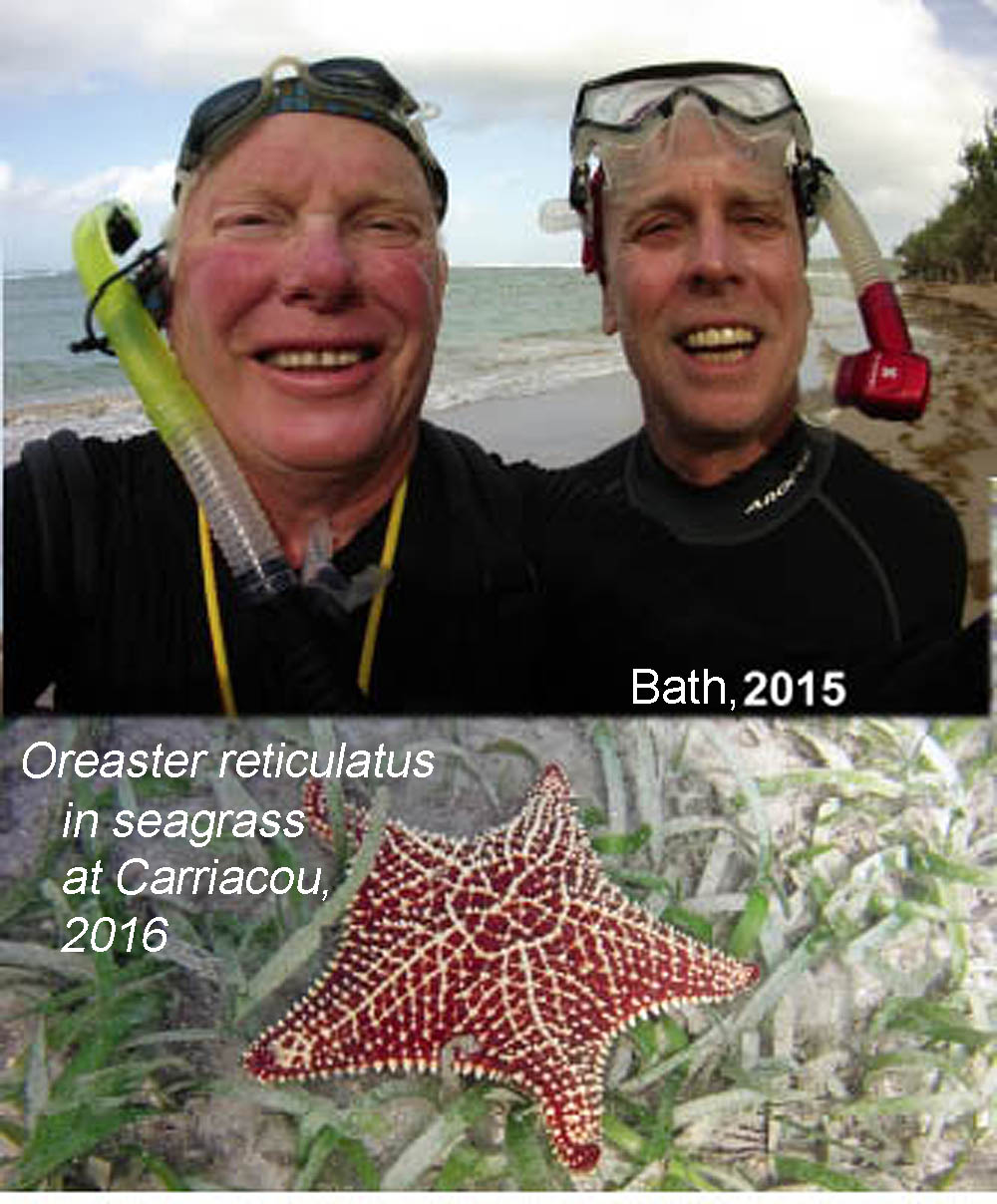
Top: With my Dal colleague, Bob Scheibling at Bath in 2015. Below: Bob had studied this seastar in Carriacou as a component of his PhD thesis (1979)
I retired in 2008. By 2014, it was “time’s up, ‘gotta do the surveys”; I conducted the surveys of the Barbados seagrass beds in the early months of 2015, and of the Carriacou seagrass beds in 2016 .*
*Again, my colleague from Dal, Bob Scheibling participated in the surveys; Bob had conducted some of his PhD research in Carriacou and followed up on some of that as well.*
* See: Distribution and abundance of the invasive seagrass Halophila stipulacea and associated benthic macrofauna in Carriacou, Grenadines, Eastern Caribbean by Robert E. Scheibling1, David Patriquin, Karen Filbee-Dexter, 2018. In Aquatic Botany.
I began work to analyze the data and publish the surveys in 2016, taking on the Carriacou data first. As it turned out, it took 8 more years to complete analyses and publish the Carriacou data in a high level journal.* *Shifts in biodiversity and physical structure of seagrass beds across 5 decades at Carriacou, Grenadines by David Patriquin, Robert E. Scheibling, Karen Filbee-Dexter. 2024. In PlosOne One factor that delayed us: in the process of preparing materials for publication, I realized that one of transects we made in 2016 was a few hundred meters from where it should have been, and it did make a difference. So Bob and I went back to Carriacou in 2019 to repeat it.
That took me to early 2024 and age 81. The Carriacou dataset was the smaller and “cleaner” of the two data sets (the Barbados set and the Carriacou set). It was clearly unlikely that I could process all of the Barbados data and get it published any time soon. On the other hand, I still want the data/observations to be available to other researchers – especially given the rapid decline in seagrass beds around Barbados in recent years – there is very little left anywhere – and I still feel an obligation to my various colleagues and sponsors to get it out.
So I am taking an approach I applied to some volunteer conservation-related studies I began at “Sandy Lake & Environs” in Bedford, Nova Scotia in 2017, and that are ongoing. I will “publish” the observations as I process them on a website – in this case, on this website.
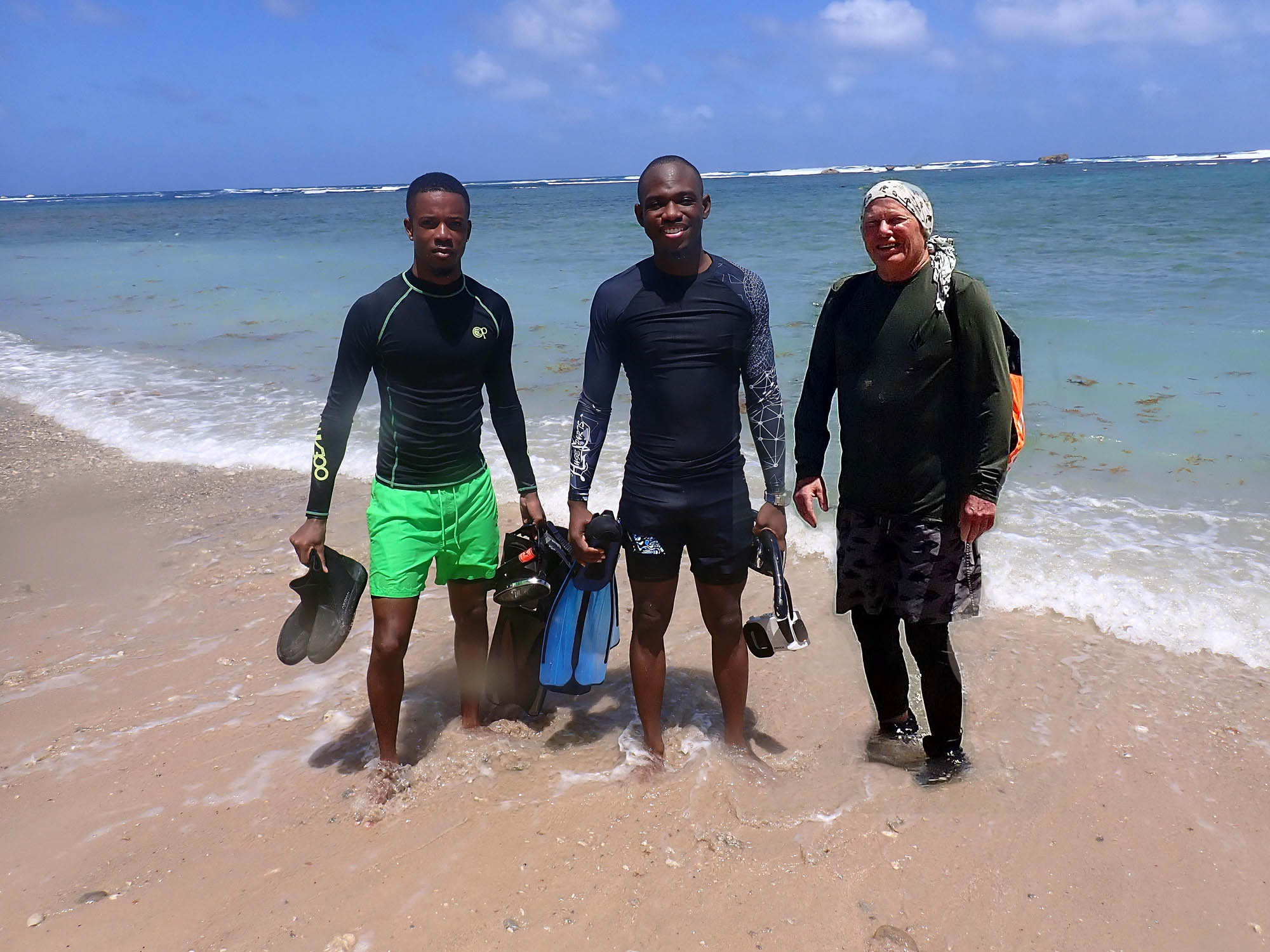
Bath 2025… With my CORALL buddies, Elon (centre) and Akeem (left)
As it turns out, these observations are also ongoing to some extent. After I conducted the 2015 (Barbados) and 2016 (Carriacou) surveys, my spouse Nina always with me, we realized we were essentially back home – we began our married life together in Barbados in 1967 – and we wanted to return in those early winter months; it was good for us. As well I had become fascinated with the Vauxhal fringing reef on the west coast… So we returned in the early months of 2017, 2018, 2019 and 2020 (the last ending with an early exit due to Covid), 2023, 2024 and 2025. Each year we would make at least one visit to Bath where we had spent so much time 1967-70. So there are ongoing observations, albeit, semi-formal and strictly descriptive, to report. My last visit to Bath, facilitated and accompanied by Elon Cadogan of CORALL, occurred in 2025, 58 years after 1967.
As matters stand in early 2026, we are not visiting Barbados this year because of medical issues, but that’s giving me time to get a good start on the “Barbados seagrass data”, and we have already reserved a place to stay again in 2027.
So bit by bit I will post the Barbados seagrass data on this website as I am able to process them… It’s a job I absolutely love to do, each item recalling earlier days… and allowing the experience all over again, in Bim or not.
ON USE OF THE DATA
These “seagrass data” (including all photos), processed/analyzed to various degrees can be utilized by anyone with an interest in them, no need to request permission. I will ensure as I can that the website remains available at least 5 years beyond my passing; regardless most or all of the contents should remain available on the web archive. Perhaps a scientific paper or two will emerge in the process (as for Sandy & Environs) and perhaps I will compile one final, comprehensive Technical Report on the Barbados seagrass. Or not. At best we can be certain only about the present.
– david p Feb 6, 2026.